

 EnglishEN
 DeutschDE
 EspañolES
 PortuguêsPT
 FrançaisFR
 РусскийRU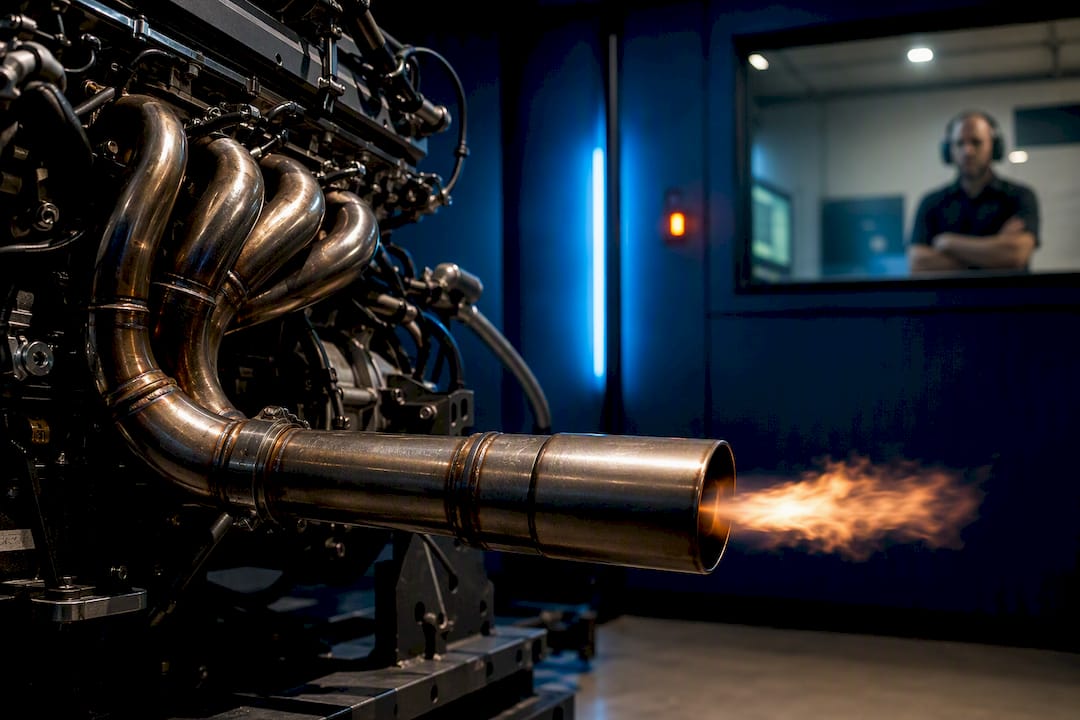
Pop and bang tuning guide workflows should treat overrun crackle as an ECU-specific combustion and exhaust-event strategy, not as a universal recipe of “add fuel + retard ignition”. Depending on the engine and ECU, the effect can involve deceleration fuel cut, ignition timing, torque request, throttle/load control, catalyst/temperature protections and mode-based activation. The correct calibration depends on the exact ECU software, exhaust hardware, catalyst/particulate-filter configuration, fuel and legal road-use requirements.
TL;DR:
- Pop-and-bang behavior is platform-specific; not every ECU uses the same overrun-fuel and ignition strategy.
- Catalyst, particulate filter, turbo, exhaust temperature and driveline implications depend on hardware and activation frequency.
- There is no universal EGT cutoff, AFR safeguard or warm-up threshold that guarantees safe operation.
- Burble, popcorn and bang labels describe sound/intensity loosely, not standardized calibration levels.
- For road vehicles, emissions, noise and roadworthiness legality must be considered separately from the calibration itself.
Pop and Bang Tuning Guide: What the ECU Actually Changes
Some implementations modify deceleration fuel cut and ignition timing, while others also use torque, throttle/load or mode-based logic. Do not assume one control recipe applies to every ECU.
Terms such as burble, popcorn and full bangs are informal sound descriptions rather than standardized calibration categories.
Exhaust architecture, turbocharger, catalyst/particulate-filter layout, pipe volume and engine configuration all influence the sound. No engine type has one predictable crackle character.
Pop and Bang Tuning Guide: Calibration and Protection Strategy
The maps involved depend on the ECU software. Relevant strategies can include overrun fueling, ignition, torque/load request, throttle, mode gating and temperature/protection logic.
Protection and activation logic should be evaluated on the actual platform. Where the ECU exposes catalyst/EGT, coolant/oil temperature, lambda, mode or load gating, those protections should remain coherent with the added overrun behavior.
- Retain catalyst/particulate-filter, exhaust-temperature and engine-temperature protections where the ECU exposes them.
- Define activation by the actual operating state: throttle/load, RPM, gear/mode and temperature as appropriate to the platform.
- Keep lambda/fueling and torque logic coherent with the overrun strategy.
- Do not disable DTC, catalyst, OPF/GPF or thermal protections merely to make the sound easier to trigger.
- Validate the effect under representative use rather than one stationary rev test.
Generic files are risky when ECU software, exhaust hardware, fuel and protection logic do not match the target vehicle. The file should be matched to the exact control-unit software and hardware configuration.
Consiglio Pro: Ask any tuner offering a pop-and-bang file whether the calibration includes an EGT cutoff and a minimum warm-up temperature. If they can’t answer specifically, walk away.
Pop and Bang Tuning Guide: Exhaust Hardware Effects
The ECU strategy and exhaust hardware jointly determine when, where and how strongly the audible event occurs.
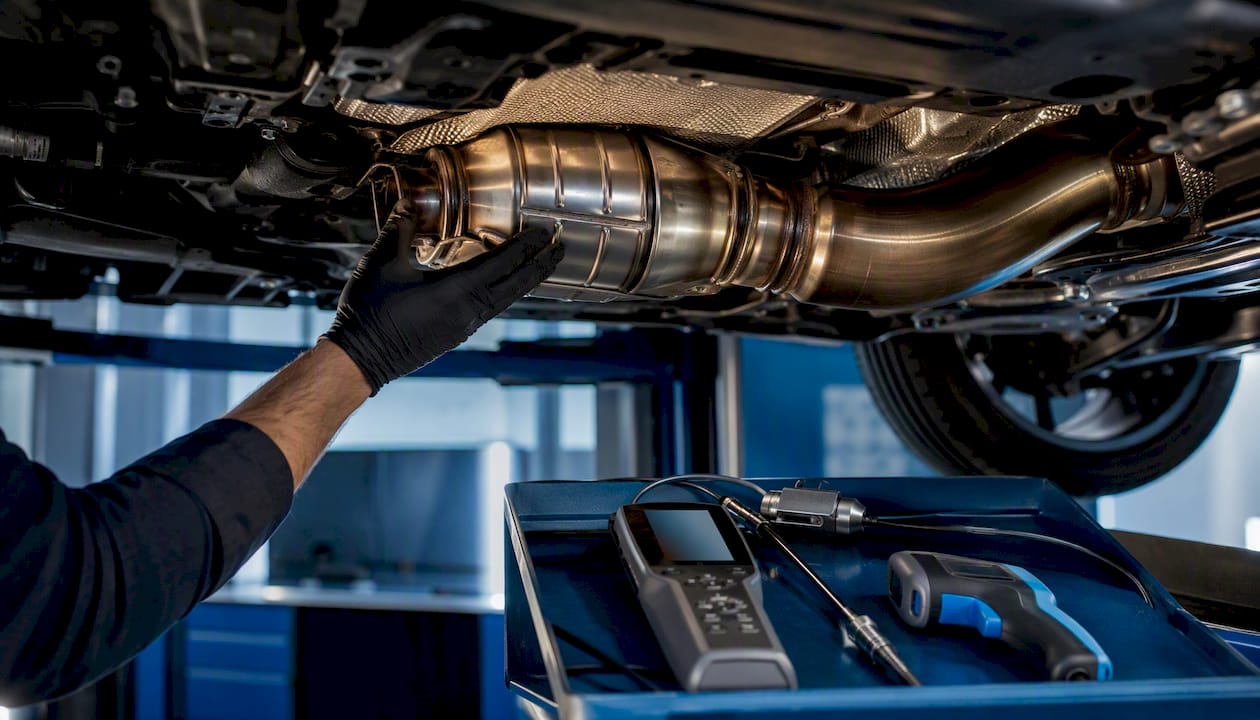
Turbocharged engines add turbine and exhaust-temperature considerations, but required thermal limits are platform-specific and should not be generalized against naturally aspirated engines.
Hardware choices that shape the outcome:
- Catalysts and particulate filters affect both sound and thermal exposure.
- Mufflers, resonators, headers/manifolds and pipe geometry change acoustic behavior.
- Turbochargers add turbine temperature and pressure considerations.
- Decat or emissions-device removal can be illegal for road use and should not be presented as a normal tuning prerequisite.
Pop and Bang Tuning Guide: Risks and Failure Modes
Overrun fuel and late combustion can raise exhaust-system heat and component stress, but the magnitude depends on engine, catalyst/filter layout, turbocharger, fuel and activation strategy.
Possible failure modes include catalyst/filter overheating, turbo/exhaust thermal stress, plug/valve deposits or heat, oil dilution and driveline effects, but their likelihood is vehicle- and calibration-specific.
- Catalyst/OPF/GPF overheating or deterioration where late combustion and fuel reach the aftertreatment system.
- Turbocharger/exhaust thermal stress on forced-induction applications.
- Spark-plug, exhaust-valve or deposit issues depending on mixture and combustion strategy.
- Oil dilution/cylinder-wall fuel exposure where excessive unburned fuel is used.
- Noise, emissions and roadworthiness non-compliance even when the engine itself remains mechanically healthy.
Validation should use the data available on the platform—DTCs, lambda, temperature, catalyst/filter status, turbo/boost data and drivability—rather than relying on one generic protection checklist.
Pop and Bang Tuning Guide: What to Verify Before Calibration
A pop and bang tuning guide should note that the viable approaches depend on ECU support, exhaust hardware and intended use. A vehicle-specific calibration is generally preferable to an unknown generic file, but the exact service model is a commercial choice rather than a technical rule.
Cost cannot be predicted from the feature name alone; ECU complexity, source-file workflow, exhaust hardware and validation requirements determine the job.
Before you commit to a tuner, run through this checklist:
- Confirm exact ECU/software ID and the exhaust/catalyst/particulate-filter configuration.
- Confirm which overrun, timing, torque and activation strategies are being changed.
- Ask which OEM protections remain active and which logs/DTCs should be checked after programming.
- Confirm the fuel grade and legal use the calibration was validated for.
- Preserve the source file and supported recovery/stock-return workflow.
Pop and Bang Tuning Guide: Burble, Popcorn and Bangs Explained
A burble usually describes a milder audible overrun effect, but the label does not guarantee lower component stress or a specific calibration strategy.
“Popcorn” is an informal description of repeated crackle events; it is not a standardized ECU strategy or safety level.
“Full bangs” generally refers to a more aggressive audible effect, but the actual fuel, ignition and torque strategy varies by ECU and tuner.
Turbo/exhaust behavior can influence the timing and character of the sound, but sound alone does not reveal whether the calibration is safe.
Why Driving Style and Fuel Quality Change the Outcome
Driving style changes how often the overrun feature activates, which can change cumulative thermal and component exposure.
Use the fuel grade and blend the calibration was validated for. Fuel quality can affect combustion and knock margin, but overrun behavior should not be described using one universal octane-risk mechanism.
Fuel-system condition and injector performance should remain part of routine diagnosis, but do not assume deposits first appear through pop-and-bang behavior.
Comparing Pop-and-Bang Behavior Across Different Vehicles
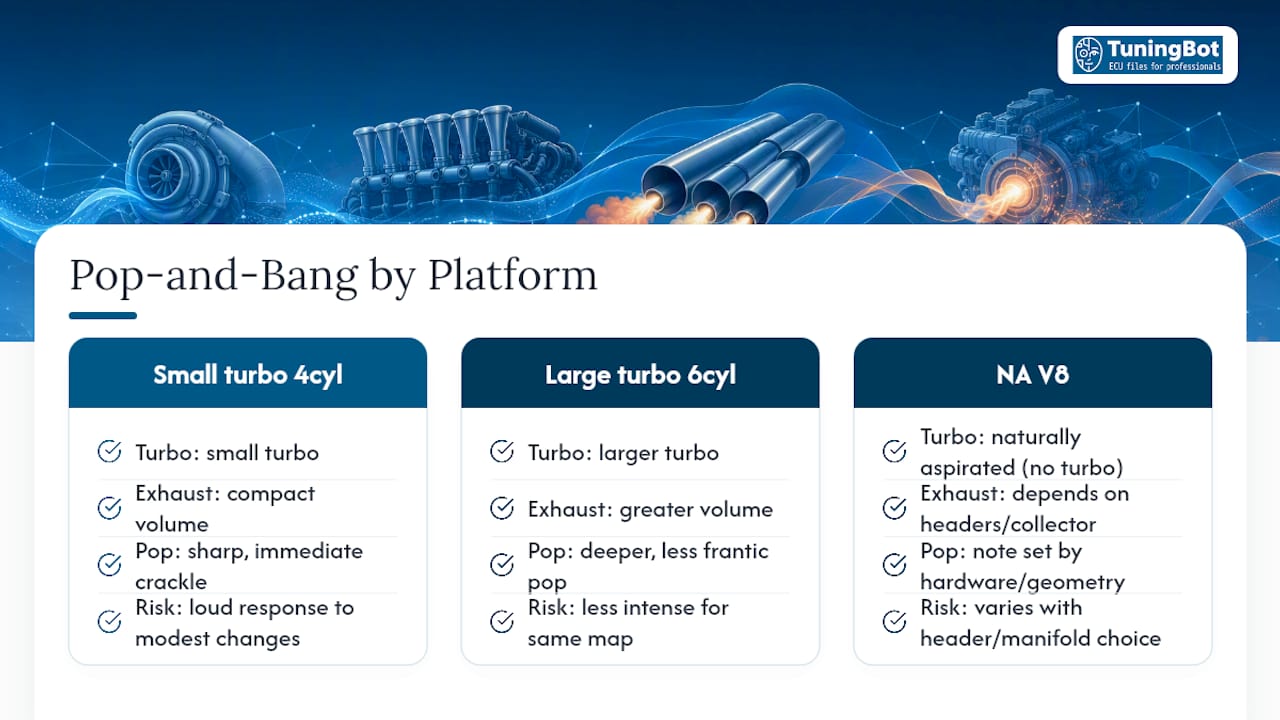
Engine displacement, turbo/exhaust architecture and pipe/catalyst volume all influence the sound. Do not predict intensity from cylinder count or turbo size alone.
Naturally aspirated engines also respond strongly to exhaust geometry, valve timing and pipe design; the exact sound remains hardware-specific.
Diesel platforms require separate consideration because combustion control, aftertreatment and particulate-filter systems differ substantially from spark-ignition engines. Do not generalize a gasoline pop-and-bang strategy to diesel applications.
The practical takeaway is that vehicle-specific ECU strategy and exhaust hardware determine the result; percentage-based fuel or timing recipes should not be transferred between platforms.
Keeping a Tuned Car Healthy Over Time
In a pop and bang tuning guide, vehicles using aggressive overrun strategies should be monitored for exhaust, catalyst/filter, turbo and fuel/oil-related symptoms according to actual use and manufacturer guidance.
Maintenance intervals should not be shortened automatically because a pop-and-bang feature exists. Inspect plugs, oil and exhaust hardware based on actual condition, logs and manufacturer/tuner guidance.
Catalyst or particulate-filter health should be monitored through DTCs, temperatures, pressure/efficiency data and physical symptoms where available.
Aftermarket Parts That Pair Well With a Pop-and-Bang Map
Exhaust hardware changes sound and thermal behavior, but aftermarket parts should be selected for legal compliance, durability and the intended acoustic result—not simply to make the effect louder.
Resonator-deleted or valved exhaust systems give drivers control over intensity, opening up for maximum crackle in performance driving and closing down for a quieter commute. Valved systems in particular solve the daily-driver dilemma: full theatrical bangs on a Saturday track day, a civil note on a Monday morning commute, controlled from inside the cabin.
Additional logging can help on development vehicles, but standalone EGT instrumentation is not mandatory for every platform if the ECU already exposes adequate temperature and protection data.
Pop and Bang Tuning Guide: Why Validation Matters
TuningBot can support pop-and-bang or related overrun calibration requests where the exact ECU, software version and requested function are covered.
Before ordering, check Copertura dei servizi ECU, rivedi il Listino Prezzi Pubblico and browse Servizi di modifica.
For related technical context, use the verified Guida alla rimappatura della mappa carburante, Errori comuni nella mappatura della centralina e Checksum Correction Guide.
Submit a supported source file through Rimappa il tuo file only after confirming the ECU, hardware configuration and legal use.
This article stays informational and technical so commercial pop-and-bang/ECU-tuning keywords remain concentrated on TuningBot’s service and order pages.
Using This Pop and Bang Tuning Guide in a Workshop
Use this guide to identify the ECU strategy, exhaust/aftertreatment hardware and validation requirements before changing overrun behavior.
If calibration is outsourced, verify the exact ECU in Copertura dei servizi ECU and submit the supported source file through Rimappa il tuo file.
The workshop remains responsible for programming conditions, legal use, emissions/noise compliance and final vehicle validation.
Sources and Further Reading
- Wikipedia — Tuned exhaust — external background reference retained unchanged.
- MotorTrend — Auto Exhaust Science — external exhaust-geometry reference retained unchanged.
- MDPI — Exhaust tuning study — external research reference retained unchanged.
- TuningBot — Fuel Map Tuning Guide — verified internal calibration reference.
- TuningBot — Common ECU Tuning Mistakes — verified internal workshop-process reference.
- TuningBot — ECU File Checksum Correction — verified internal integrity reference.
FAQ
What Is a Pop and Bang Tune?
A pop-and-bang tune changes overrun combustion/exhaust behavior to create audible crackle or pops. The exact ECU strategy varies by platform.
How Much Does a Pop and Bang Tune Cost?
There is no universal price. Cost depends on ECU support, source-file workflow, exhaust hardware, calibration complexity and validation requirements.
Is a Burble Tune Worth It?
A burble is only an informal description of a milder sound. Whether it is worthwhile or lower-risk depends on the actual calibration, exhaust hardware, legal use and activation frequency.
Do Pops and Bangs Damage an Engine?
They can increase exhaust and aftertreatment stress depending on how the calibration is implemented and how often it activates. No protection strategy can make aggressive overrun behavior universally risk-free.