

 EnglishEN
 DeutschDE
 EspañolES
 PortuguêsPT
 FrançaisFR
 РусскийRU
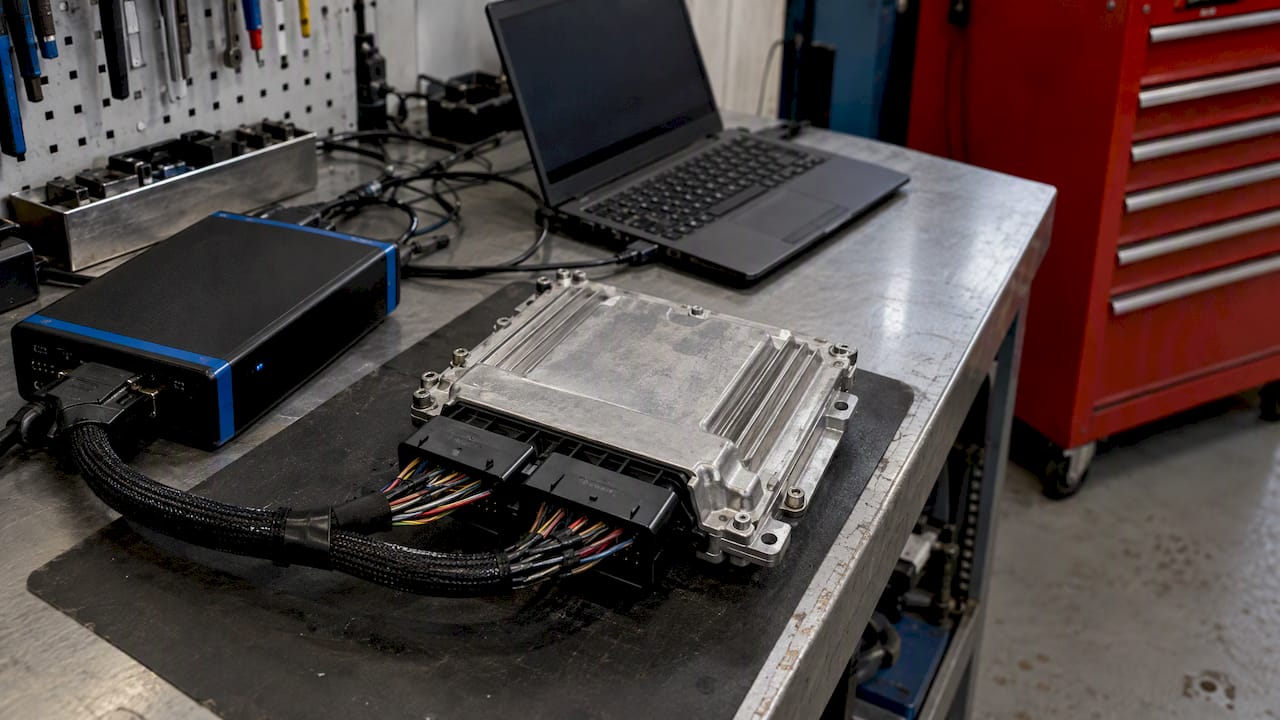
Mapping cars means changing the calibration used by an engine control unit. A remap can alter how torque requests, airflow, fuel, ignition and other functions are coordinated, depending on the controller. Understanding the actual changes matters more than a stage label: the same advertised stage can describe different hardware, fuel requirements and validation work.
Mapping cars: what an engine map actually contains
An ECU calibration includes tables, curves, constants and configuration data used by its control software. Maps may relate values to engine speed, load, temperature or other variables, but not every function is a simple RPM-versus-load table. Some controllers use calculated models and coefficients alongside conventional lookup tables.
Sensor readings, requested torque, limits and feedback influence the final commands. The ECU does not simply read one “power map” and send its values directly to the engine. A table edit may be constrained or corrected elsewhere in the strategy.
- Driver demand and torque: translate requests and coordinate available output with other systems.
- Air-path control: manage relevant throttle, boost, airflow and related functions.
- Fuel control: calculate delivery and targets using the injector, fuel and combustion strategy.
- Ignition: determine spark timing and applicable corrections on spark-ignition engines.
- Protection and diagnostics: respond to operating limits, implausible signals and detected faults.
Not every engine has every function: a naturally aspirated engine has no turbo boost target, and diesel combustion is not calibrated through spark-advance tables. The Guida alle tecniche ECU remapping gives more technical context.
Stage 1, Stage 2 and Stage 3 are provider labels
Stage names are commercial conventions rather than a common technical standard. A provider may use Stage 1 for a stock-hardware calibration, Stage 2 for a defined package of modifications and Stage 3 for a more extensive build. Another provider can use the same labels differently.
| Advertised label | Common interpretation | What must still be specified |
|---|---|---|
| Stage 1 | A calibration intended for a stated stock-hardware configuration. | Exact vehicle variant, fuel, condition and operating limits. |
| Stage 2 | A calibration for a defined set of supporting changes. | Actual part numbers and specifications, rather than a generic list. |
| Stage 3 | A provider’s designation for a more extensive build. | Complete hardware, control strategy and validation requirements. |
These descriptions do not establish power gains, durability, emissions compliance or a required parts list. A stage number also says nothing about whether a calibration was developed specifically for the installed combination. Ask for the configuration and intended operating conditions in plain terms.
Fuel changes need the same precision. An ethanol conversion may require suitable hardware, composition information and calibration; it is not automatically included in a numbered stage. See the E85 conversion guide.
What a remapping job should record
Begin with the vehicle’s condition, controller identification and existing software. Archive the scan and relevant measurements before clearing faults. An intake leak, weak fuel supply or worn drivetrain can change the result and should not be disguised by calibration edits.
The access method depends on the ECU, software protection and tool support. OBD, bench and boot access do not describe interchangeable procedures. A direct read, a virtual read and a wider memory backup can contain different data, so record which one the tool supplied. A saved file is not proof that every memory region can be restored.
Match proposed changes to the hardware and fuel, and document the version written. The required integrity handling may include checksums and other platform-specific mechanisms. A correct checksum alone does not prove compatibility or calibration quality; our checksum guide explains its narrower role.
Follow the tool’s programming instructions and power requirements. Afterward, complete the specified procedures and evaluate relevant logs, faults and vehicle functions. The needed checks depend on what changed; there is no universal promise that every job takes the same amount of time or needs the same test sequence.
Distinguish measured gains from changed response
A sharper pedal response can make a car feel faster without increasing its maximum output. Likewise, a larger peak number does not describe the full torque curve, repeatability, thermal behavior or drivetrain loading. Compare like-for-like measurements and document fuel, temperatures and test conditions.
There is no guaranteed percentage gain for a mapped car. Turbocharged engines can offer different adjustment opportunities from naturally aspirated engines, but usable margins depend on the actual turbocharger, fuel system, combustion limits, cooling, drivetrain and calibration. Factory output should not be treated as proof of unused safe capacity.
Fuel economy also needs a valid comparison over comparable use. Trip-computer readings alone may be misleading if the relationship between modeled fuel consumption and delivered fuel has changed. Increased low-speed torque is not automatically beneficial when the clutch, transmission or thermal limits are already constraining the application.
Remap and piggyback: compare the specific implementation
A remap changes data or software in the original ECU. A piggyback is an additional controller whose function depends on the product: some alter selected sensor signals, while others provide more extensive control or integration. Neither label alone establishes quality, reversibility or suitability.
Changing a signal can affect both control and diagnosis if the ECU relies on that signal. A remap can also alter or disable protective behavior if implemented incorrectly. It is therefore inaccurate to claim that every remap preserves all safeguards while every piggyback bypasses them. Evaluate the actual functions affected, compatibility and test evidence.
Compare the scope of the quote
A workshop quote may include diagnosis, access or unlocking, calibration work, test time and follow-up checks. A file charge describes only part of that work. Hardware, fitting and other repairs can be separate. Compare the same deliverables before comparing totals.
Il current TuningBot price list is the appropriate place for service prices. A technical article should not turn a generic stage label into a fixed installed price, a coverage promise or a delivery guarantee.
Check emissions, inspection and contractual requirements
A performance or drivability label does not by itself establish legal compliance. Changes to combustion calibration can affect emissions even when the exhaust hardware remains installed. EPA guidance describes both hardware and software forms of tampering and explains why “off-road” wording is not a blanket exemption for a certified vehicle.
UK inspection requirements should also be stated precisely. The MOT inspection manual identifies emissions-equipment and test defects; it does not create a general rule that every remapped vehicle must first be returned to factory software. Passing a periodic inspection is not proof that every aspect of a modification is approved.
Check the rules applicable to the vehicle, its use and jurisdiction, together with the actual insurance and warranty terms. Do not assume either that every modification voids all cover or that it has no effect on a related claim.
Basic preparation remains useful: the engine-bay cleaning guide offers maintenance context, but vehicle-specific precautions come first. A tidy engine bay may help reveal leaks or damaged wiring; it does not validate a calibration.
Domande frequenti
What does mapping a car mean?
It means changing the calibration used by the engine control unit. The functions affected depend on the ECU and the work specified; a remap is not a single universal power setting.
Are Stage 1, Stage 2 and Stage 3 standardized?
No. They are provider-defined labels. Compare the actual hardware, fuel, intended output and validation requirements rather than relying on the stage number.
Does remapping always increase power?
No. The outcome depends on the engine, hardware, fuel, condition and calibration objective. A sharper pedal response alone does not demonstrate increased maximum output.
Is a remap always safer than a piggyback?
No. Both require application-specific assessment. Examine what the system changes, how control and diagnostic functions are affected, and what validation supports the result.
Is a file-service price the total cost of remapping a car?
No. Diagnosis, tool access, installation, hardware and vehicle testing may be separate. Compare quotes using the same scope of work.
Approfondimenti
The resources below provide consumer explanations and background. Their price examples, stage definitions and legal discussions need to be read in their own context.
- Engine maps: what you need to know
- Engine Control Units (ECUs): a complete guide, RAC Drive
- ECU Remap vs Piggyback Tuner comparison
- Car remapping: what is it and how does it work?
- Engine Remapping: What Is Remapping a Car?
- State of Maine and Maine Department of Environmental Protection complaint
- Aftermarket engine tuning: pro and con