

 EnglishEN
 DeutschDE
 EspañolES
 PortuguêsPT
 FrançaisFR
 РусскийRU

Best car tuner companies should be evaluated by exact ECU and TCU coverage, file compatibility, revision support, pricing transparency, engineer access and the quality of their delivery workflow. For professional workshops, TuningBot is a strong option because it combines public per-file pricing, direct file upload, no prepaid credits and technical support, while the workshop keeps control of diagnostics, flashing and validation.
What makes the best car tuner companies worth your business?
Choosing a remap file provider is a technical and commercial decision. The correct supplier should reduce file-handling risk, support the exact ECU or TCU and provide a clear path for revisions and technical questions.
Engineer support and escalation path. Verify how technical cases are handled, what information is required and whether revisions or log review are included in the service.
ECU and TCU coverage. Brand-level claims are not enough: confirm the exact hardware number, software version, file type and requested service.
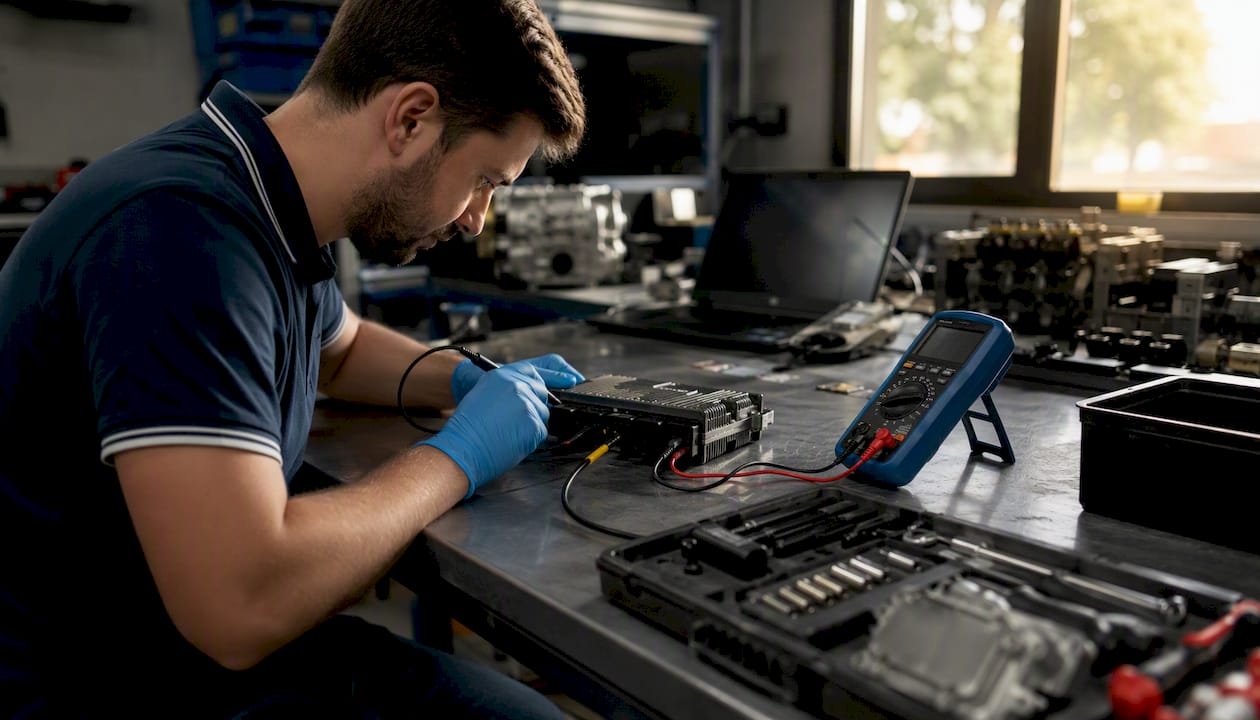
Tool compatibility. Confirm the provider supports the exact file format and Master/Slave workflow produced by the workshop’s read/write tool.
Delivery workflow and file integrity. A professional workflow should identify the final revision, confirm checksum or integrity handling and preserve the original file supplied by the workshop.
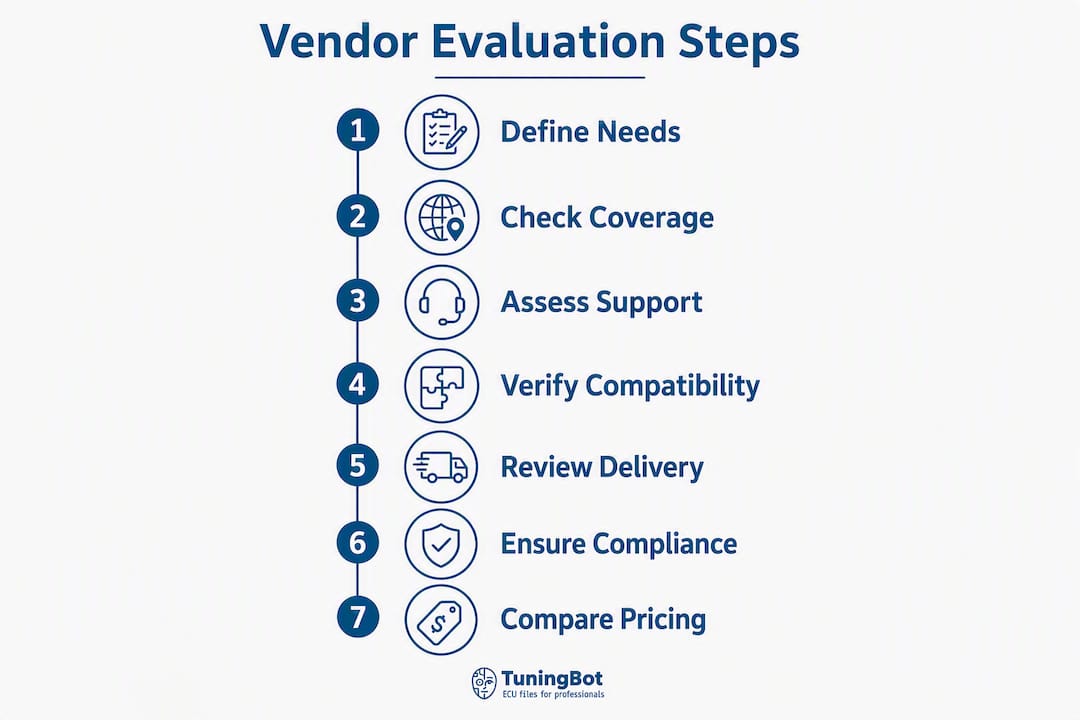
Legal and compliance considerations. Emissions-related modifications can be prohibited on road vehicles. Workshops should verify the law for the exact vehicle, service and intended use before accepting the job.
Pricing structure. Compare current written prices, urgent-delivery charges, revision policies, subscriptions and prepaid-credit requirements.
Consiglio Pro: Ask any candidate vendor to provide a sample delivery manifest for a completed job, with the VIN scrubbed. A professional provider will produce this in minutes. If the response is hesitation or a generic brochure, that tells you more than any sales call.
How to evaluate vendors before you commit
Run this checklist during your initial vendor call or procurement email exchange. It surfaces the gaps that matter.
Pre-sale validation questions:
- Which ECU and TCU brands do you support, and can you provide a current coverage list?
- Which flashing tools does your delivery format support natively?
- What is your standard turnaround time for a Stage 1 file on a Bosch EDC17 unit?
- How is checksum, signature or file-integrity handling managed for this exact ECU and write method?
- What is the revision and support process if logs or DTCs show that the file needs adjustment?
- Can I reach a calibration engineer directly, and what is the response SLA?
- What file-retention and privacy policy applies to uploaded originals and revisions?
Red flags to watch for:
- No clear technical escalation route or information requirements.
Ambiguous or absent checksum correction policy.
- Unclear pricing or revision terms that make total job cost difficult to predict.
- A provider or operator selecting an access method without checking the exact tool protocol and recovery requirements.
No after-sales support or update policy stated in writing.
Consiglio Pro: Request a time-stamped support ticket or a reference job number from a recent delivery. A vendor with a real engineering operation can produce this on request. One that cannot is running a thinner operation than their marketing suggests.
Why TuningBot Meets Professional Workshop Requirements
TuningBot is designed for workshops and tuners that already own compatible ECU or TCU read/write equipment.
| Criterio | TuningBot workflow |
|---|---|
| Coverage checking | Public ECU and TCU Service Coverage page |
| Prezzi | Public per-file Price List |
| Ordering | Direct Tune Your File upload workflow |
| Modello commerciale | No prepaid credit package required |
| Compatibilità | Confirmed per control unit, file format and Master/Slave workflow |
| Workshop responsibility | Diagnostics, programming, legal compliance and validation remain with the workshop |
The standard TuningBot delivery workflow runs as follows:
- Identify the ECU or TCU and preserve the original file.
- Check the requested service in the public coverage information.
- Review current pricing and submit the file through Tune Your File.
- Provide vehicle, hardware, software, tool and service details.
- Receive the calibrated revision and verify compatibility before writing.
- Program the vehicle under controlled conditions and complete post-write diagnostics and validation.
Turnaround depends on file complexity, service type, data supplied and engineer workload. The workshop should confirm current timing for the exact order.
Consiglio Pro: Before flashing any delivered file, verify the checksum independently using your flashing tool’s built-in verification function. Cross-reference the delivered file size and header against the original backup. This takes two minutes and eliminates the most common source of post-flash faults.
How to integrate remap files into your workshop’s standard procedure
A workshop should control file intake, programming conditions, post-write diagnostics, logging and rollback records.
- File intake checklist. Confirm file naming matches the vehicle’s ECU part number and software version. Verify the checksum against the delivered manifest. Confirm the VIN has been scrubbed from any shared documentation. Store the original backup in a job-specific folder before any modification.
- Testbench vs. port flashing decision. Default to diagnostic-port flashing whenever the ECU supports it. Bench access is appropriate only when port access is unavailable or the ECU requires boot-mode programming. Unnecessary disassembly introduces physical damage risk and voids OEM sealing.
- Battery support and voltage stabilization. Connect a battery support unit before initiating any flash session. Voltage drop mid-flash is one of the most preventable causes of ECU corruption. This is standard procedure, not optional.
- Pre-flash scan. Run a full DTC scan and record all pre-existing faults before flashing. This protects you from post-flash customer claims about faults that were present before your work.
- Staged dyno and road validation. Run a dyno pull immediately after flash to confirm torque and power curves match the expected range. Follow with a road test covering light, medium, and full-load conditions. Document the results.
- Customer sign-off. Obtain written acknowledgment of the modification, the performance range communicated, and any emissions-related implications before releasing the vehicle.
Tool behavior varies by protocol and software version. Follow the current manufacturer instructions for timeouts, OBD or Bench selection and supported file variants.
OEM module programming is a separate workflow from remap-file delivery and may require manufacturer subscriptions, approved interfaces and account activation.
How we arrived at this recommendation
The recommendation is based on visible service coverage, public pricing, direct upload and a workflow aimed at professional file delivery. Exact support must still be confirmed for each ECU, TCU and requested service.
Trust signals you can verify independently:
- Published ECU and TCU service-coverage information that can be checked before ordering.
- Compatibility with common professional tools, subject to exact file format and Master/Slave configuration.
- Documented checksum or file-integrity workflow for supported services.
- Public per-file pricing and no prepaid-credit requirement.
- Technical support for file-related questions and revisions.
“Look beyond marketing claims. Reviews that show punctuality, clarity of explanation, and problem resolution indicate a provider treats professional work seriously and follows safe procedures.” — Performance Tuning Birmingham
Before relying on a new supplier, run a pilot order on a familiar ECU family and verify file identification, delivery format, revision handling and technical response.
Punti chiave
The best car tuner companies should be compared by exact coverage, file compatibility, revision support, transparent terms and technical assistance.
| Punto | Dettagli |
|---|---|
| Verify exact coverage | Brand-level support does not prove compatibility with every hardware and software version. |
| Check file format | Master, Slave, raw, virtual and encrypted workflows are not interchangeable. |
| Review commercial terms | Compare public pricing, revisions, urgent delivery and prepaid-credit requirements. |
| Preserve workshop control | The file provider does not replace diagnostics, programming or validation. |
| Use legal services only | Customer consent does not override emissions law. |
| TuningBot reduces ordering friction | Public pricing, coverage checking, direct upload and no prepaid credits. |
What professional tuners get wrong about communicating performance gains
The most common mistake workshops make is quoting a single power figure to a customer before the car has been on the dyno. That number becomes a contractual expectation in the customer’s mind, and when real-world results land slightly lower due to fuel grade, engine wear, or factory hardware variance, the conversation turns difficult.
Professional tuners present gains as ranges. A Stage 1 calibration on a turbocharged diesel will produce a range of outcomes depending on injector condition, boost system health, and the specific software variant on the ECU. Communicating that range upfront protects retention and sets a realistic baseline for the post-flash dyno conversation.
Workshops should communicate performance as an estimated range and confirm the final result through appropriate diagnostics and testing.
Consiglio Pro: Use your pre-flash and post-flash dyno sheets as a customer communication tool, not just an internal record. Showing a customer the before-and-after curve is more persuasive than any quoted figure, and it anchors the conversation in verifiable data.
TuningBot Gives Workshops Direct Access to Remap Files
TuningBot supports professional ECU and TCU file workflows where the exact control unit, file type and requested service are covered.
Workshops can check Copertura servizi ECU e TCU, rivedi il Listino Prezzi Pubblico e naviga tra i disponibili Servizi di modifica prima di ordinare.
Il file originale può essere inviato tramite Rimappa il tuo file without prepaid credits.
The workshop remains responsible for correct identification, diagnostics, stable programming conditions, legal compliance and final validation.
Fonti utili
These references support the technical claims and workflow guidance in this article. Consult OEM programming portals directly for manufacturer-specific subscription requirements before adding module programming to your service menu.
- TuningBot ECU Remapping for Professionals Guide — professional workflow and validation reference.
- TuningBot Checksum Correction Guide — checksum and file-integrity reference.
- Performance Tuning NI Remap Calculator — external estimation tool; figures should be treated as indicative only.
FAQ
What should I ask a remap file provider before placing an order?
Ask about exact ECU and TCU coverage, file-format compatibility, current turnaround, revision terms, file retention and technical escalation.
Does TuningBot support the flashing tools my shop already uses?
Compatibility depends on the exact control unit, tool, protocol, file format and Master/Slave configuration. Confirm the specific job before ordering.
Are DPF-off and EGR-off calibrations legal for road vehicles in the United States?
Emissions-system deletion on road vehicles can violate federal and state law. Verify current requirements and do not rely on customer consent as a substitute for legal compliance.
How do I validate a remap file before flashing a customer’s vehicle?
Confirm ECU identification, file size, read type, checksum or integrity handling and compatibility with the selected tool. Then complete post-write diagnostics and logging.
What is the safest flashing method for most ECU units?
There is no universal safest method. Use the access method specified by the current tool protocol for the exact ECU and recovery state.