

 EnglishEN
 DeutschDE
 EspañolES
 PortuguêsPT
 FrançaisFR
 РусскийRU

6.0 Power Stroke tuning changes the calibration of a diesel engine whose fuel injection depends on both its fuel supply and high-pressure engine-oil system. A useful workshop assessment starts with the truck’s condition, software identity and intended workload. Peak dyno figures from another truck cannot establish the output or durability of this one.
6.0 Power Stroke tuning: understand the control system
The 6.0L uses hydraulically actuated, electronically controlled unit injectors. High-pressure engine oil operates the injector mechanism; the low-pressure fuel system supplies diesel to the injectors. Injection control pressure, commonly logged as ICP, describes the oil side of this process. It is not a common-rail fuel-pressure measurement.
Motorcraft’s technical training catalog separates HEUI fuel-system, high-pressure oil and FICM diagnosis. Keeping those systems distinct helps a workshop interpret a pressure or starting complaint without blaming the calibration prematurely.
Calibration can influence injection timing and duration, commanded injection control pressure, variable-geometry turbo operation and torque delivery. The standard turbo uses variable geometry, so a generic reference to wastegate tuning does not describe the original arrangement. Replacement turbo hardware must be identified separately.
Transmission behavior also depends on the truck’s actual configuration and controller strategy. A transmission adjustment is relevant to an electronically controlled automatic, but should not be assumed part of every engine-file request.
Build a diagnostic baseline before selecting output
Record the application, engine and controller identification, installed software, transmission, modifications and service history. Do not infer the complete specification from a badge or a broad model-year range. Save existing fault codes and freeze-frame information before clearing anything.
| Sistema | What to establish |
|---|---|
| Fuel supply | Fuel quality, filter history and supply-pressure behavior under the relevant load, using the applicable Ford test procedure. |
| High-pressure oil | Starting behavior and agreement between requested and measured ICP, interpreted with oil temperature, regulator command and the correct diagnostic criteria. |
| Electrical and FICM | Battery, cranking and charging condition; distinguish module supply voltage from injector-drive voltage. |
| Air and turbo | Intake or charge-air leaks, sensor plausibility, exhaust restrictions and VGT response. |
| Cooling and sealing | Coolant loss, overheating history and evidence from tests that distinguish external leaks, cooler faults and combustion leakage. |
| Trasmissione | Shift quality, clutch or converter behavior, fluid condition and known repair history. |
Choose tests from the symptoms and service information. A hot-start fault and a sustained-load complaint may require different evidence. A single scan value at idle cannot establish how the fuel, oil or cooling systems behave during the intended duty cycle.
Assess head sealing without a universal power threshold
Higher cylinder loading can increase the demands on head sealing and other components. However, there is no single horsepower figure or tune label that determines whether every engine needs the same fastener work. Condition, assembly quality, thermal history and the actual combustion loading matter.
The retained DrivingLine head-bolt article e Diesel World overview of common problems provide background. They should not become a universal permission to add torque below a quoted number, or a claim that upgraded fasteners alone make a build reliable.
Coolant residue or loss warrants diagnosis; it does not, by itself, prove a failed head gasket. Confirm the cause before selecting repairs or changing the calibration. A software file cannot repair a leaking cooler, damaged sealing surface or fuel-supply fault.
Use the maintenance schedule for the application
Ford’s diesel maintenance reference distinguishes normal and special operating conditions, including towing, extended idling and dusty operation. The illustration summarizes its 6.0L entries; confirm the schedule applicable to the specific vehicle and use whichever applicable distance, time or engine-hour limit is reached first.
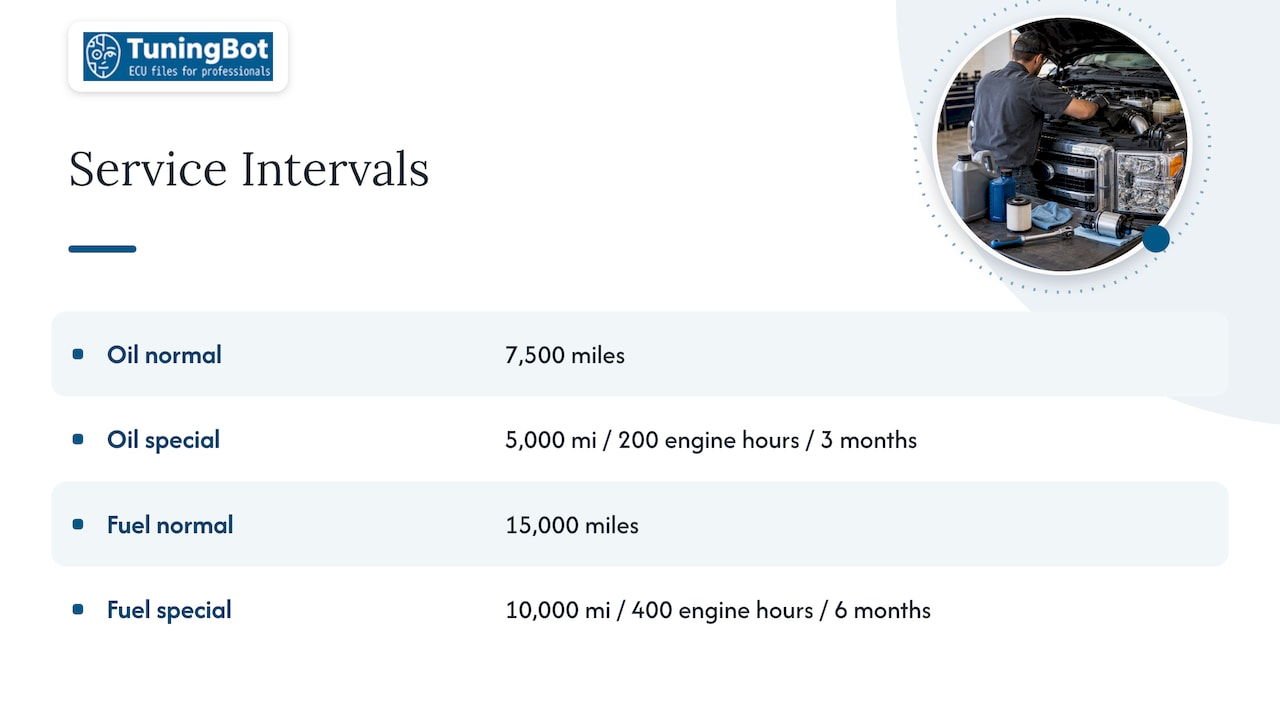
The document also describes normal fuel-filter service as every other oil change. Keep the actual service records and follow the vehicle’s applicable instructions rather than extending an interval because a tune feels smooth.
Compare calibration scope, not canned-versus-custom labels
A preconfigured calibration is built around a defined set of assumptions. A custom calibration can account for documented hardware and operating requirements, but the label alone does not demonstrate better engineering or a larger safety margin.
Il Diesel World tune comparison reports examples from particular vehicles and tests. Its output figures are not guaranteed gains, directly transferable limits or proof that every custom file outperforms every preset file.
Supply injector and turbo specifications, tire size, axle ratio, transmission details, fuel information and intended duty. Sustained towing emphasizes cooling, driveline load and repeatable behavior in ways that a brief acceleration test does not reproduce. Calibration does not change the vehicle’s approved towing or weight ratings.
Remote and on-site calibration both need reliable identification and validation. Neither method establishes a fixed power advantage or a mandatory number of revisions. Agree on the work and evidence required for the actual truck.
Validate under the intended operating conditions
Compare relevant baseline and post-programming data: requested and measured ICP, fuel supply where instrumented, boost and VGT behavior, temperatures and automatic-transmission operation where applicable. Identify which channels are measured, inferred or unavailable.
Exhaust-gas temperature is useful only with its sensor location, response and operating conditions understood. A pre-turbo reading cannot be compared directly with a post-turbo threshold, and a rise in temperature does not identify a unique cause. Set test limits from the actual hardware and applicable technical information.
Use the diesel torque guide to understand related calibration checks. Keep the original read, its coverage, the final file and test records. A stored file does not guarantee recovery from every programming failure.
Keep emissions configuration and service terms specific
Do not transfer emissions-system assumptions from later Power Stroke generations to the 6.0L. Identify the equipment fitted to the truck and any retrofit; the factory 6.0L configuration is not the later DPF-and-SCR/AdBlue arrangement. Our EGR diagnostic guide explains relevant software and hardware distinctions.
The EPA references below concern enforcement history across particular products and cases. They do not establish emissions multipliers for this engine or approval for an individual modification. Assess applicable requirements for the actual vehicle and work.
For a file inquiry, provide the verified controller and vehicle details and consult the current service information. Confirm coverage and scope for the specific request rather than relying on generic turnaround, compatibility or guarantee statements.
Domande frequenti
Is ICP the same as common-rail fuel pressure?
No. On the 6.0L Power Stroke, injection control pressure refers to the high-pressure oil used to actuate the unit injectors. The fuel-supply system is separate.
How much power will a tune add?
There is no universal figure. Output depends on the engine’s condition, hardware, calibration, fuel and test method. Another truck’s dyno result is not a guarantee.
Are upgraded head fasteners always required?
The appropriate work depends on the intended loading and the engine’s condition and assembly. A single horsepower threshold cannot determine this for every vehicle.
Does coolant residue prove a head-gasket failure?
No. It is evidence to investigate, but the cause must be distinguished from other cooling-system or sealing faults using the applicable diagnostic tests.
Is a custom tune automatically better than a preset tune?
No. The important questions are whether the calibration fits the documented configuration and use, and what validation supports it.