ItalianoIT
 DeutschDE
 EspañolES
 PortuguêsPT
 FrançaisFR
 РусскийRU
How remap affects torque curve shape depends on the engine, turbocharger, fuel system, torque model, drivetrain and calibration objective. A professional remap can change torque onset, plateau width, peak value and high-RPM taper, but earlier or higher torque is not automatically better. The correct curve must balance drivability, thermal control, traction and mechanical limits.
The core effects at a glance:
- Torque onset shifts earlier in the RPM range, improving low-speed response and reducing lag
- The usable plateau widens, so the engine pulls strongly across a broader band without requiring a downshift
- Peak torque typically rises, with turbo petrol Stage 1 remaps showing noticeable gains, turbo diesels increasing significantly, and naturally aspirated engines showing smaller improvements
- Delivery becomes smoother, removing factory flat spots introduced for emissions and comfort compliance
- Mechanical limits (clutch capacity, gearbox torque thresholds, turbo operating range) define the ceiling — not software ambition
For tuners, three parameters demand immediate attention:
- Torque onset RPM: aggressive low-RPM torque is the primary cause of clutch slip and dual-mass flywheel stress
- Gearbox and clutch torque capacity: these are hard mechanical ceilings, not conservative OEM margins
- Map objective: a torque-oriented map (mid-range shape) and a power-oriented map (peak HP at high RPM) require different table strategies and suit different use cases
What the torque curve actually tells you
A torque curve plots measured or calculated engine or wheel torque against engine speed. Its interpretation depends on dyno type, gear, correction method, drivetrain losses and test conditions.
Five features define a torque curve’s character:
- Torque onset: the RPM at which meaningful torque first appears. Earlier onset means the engine responds before the driver needs to rev it up, which is especially relevant in turbocharged engines where boost builds progressively.
- Peak torque: the maximum value and the RPM at which it occurs. A lower peak RPM generally means stronger low-speed pull.
- Plateau width: the RPM band over which torque stays near its peak. A wide, flat plateau means the engine delivers consistent force across a large speed range.
- Taper and drop-off: how quickly torque falls above the peak. A steep drop-off forces more frequent downshifts on the road.
- Area under the curve: a useful comparative measure across a defined RPM range, provided the dyno method and units are consistent.
Curve shape differs by engine architecture, turbo system, displacement, gearing and calibration. Platform-specific exceptions are common.
Linking curve features to driver experience:
- Earlier onset → stronger response from low speed, less need to build revs before pulling
- Wider plateau → fewer downshifts on highway overtakes, more relaxed cruising
- Smoother taper → predictable behavior at the top of the rev range, no sudden power loss
- Larger area under curve → the engine feels stronger across all conditions, not just at peak
How remapping changes the torque curve: the ECU parameters involved
Modern ECUs can manage torque through multiple request, limit, monitoring and protection paths. The exact architecture varies by ECU.
The primary parameters a tuner modifies:
- Requested torque tables (pedal-to-torque mapping): these translate accelerator position into a torque request. Remapping these tables sharpens throttle response and removes the deliberate delay OEMs introduce for comfort and emissions compliance.
- Boost target / MAP tables: raising boost pressure targets increases charge density, which directly raises torque output. Widening the RPM range over which the boost target is held extends the plateau.
- Fueling and injector maps: more air requires proportionally more fuel. Correcting the fueling map prevents lean conditions at higher boost and supports the torque increase without over-fueling.
- Ignition timing advance: advancing timing at mid-load conditions increases combustion efficiency and raises mid-range torque. The limit is knock — advancing too far on a given fuel quality triggers detonation, which the ECU’s knock sensors detect and retard against.
- Torque limiters (gear, temperature, oil pressure): the ECU applies torque caps by gear, coolant temperature, and oil pressure. Remaps adjust these limiters to allow the requested torque to reach the engine, rather than being clipped before combustion.
- Variable geometry turbo (VGT) and wastegate strategies: adjusting VGT vane position or wastegate duty cycle controls how quickly boost builds and how it holds across the RPM range. Sharper VGT response reduces lag but increases transient thermal load.
- EGR and aftertreatment interaction: on diesels, EGR rate affects charge temperature and oxygen availability. Remaps often reduce EGR at load to improve combustion quality and torque delivery, though this has emissions compliance implications.
Many modern ECUs use torque-based control, while others use different or mixed strategies. A correct remap preserves coherent feedback, plausibility and protection functions.
Petrol and diesel engines have different combustion and control constraints. Petrol calibration must consider knock, lambda and exhaust temperature; diesel calibration must also manage smoke, rail pressure, air charge, EGT and aftertreatment behavior.
Torque-based vs. power-based maps, and what stage levels mean
Not all remaps pursue the same objective. The distinction between a torque-oriented map and a power-oriented map determines where gains appear on the curve and which customers benefit most.
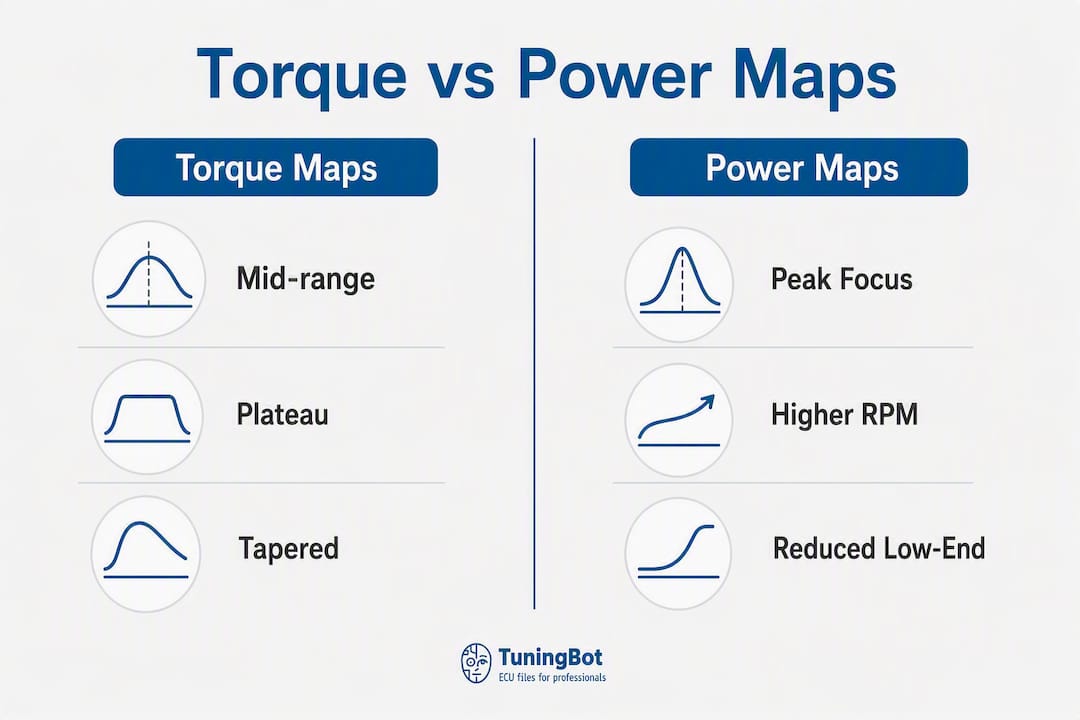
A torque-oriented calibration prioritizes usable mid-range delivery and controlled onset. The useful RPM range depends on the specific engine and gearbox.
A power-oriented calibration places more emphasis on maintaining airflow and torque at higher RPM while retaining controlled mid-range delivery and protections.
Stage definitions in practical terms
- Stage 1: commonly a calibration on standard hardware; definitions vary by provider.
- Stage 2: commonly a calibration matched to specified supporting hardware; the parts list is platform-specific.
- Stage 3: an informal label for more extensive hardware changes; no universal definition exists.
Stage 1 gains vary widely by engine family, factory calibration, fuel quality, hardware condition and test method. Use platform-specific evidence rather than universal percentage ranges.
For tuners selecting a map approach:
- Daily driving: prioritize smooth, usable torque and controlled low-RPM loading.
- Towing: verify legal use, cooling, gearbox temperature and drivetrain capacity before increasing torque.
- Track use: prioritize repeatability, cooling, fuel pressure and high-RPM airflow.
- Efficiency objective: validate real fuel consumption under comparable routes and loads.
How to read before/after dyno torque curves
A dyno chart should be interpreted together with test conditions, correction method, gear, temperatures and supporting logs.
- Earlier torque onset: the RPM at which the curve crosses a meaningful threshold (e.g., 80% of peak) should shift left compared to the stock trace.
- Wider plateau: measure the RPM band where torque stays within 10% of peak. A wider band means more usable mid-range.
- Smoother taper: the post-peak drop should be gradual, not a cliff. Sudden drop-off above peak RPM often indicates a boost cut or fueling limit.
- No oscillations or spikes: torque oscillations on the trace suggest boost instability, fueling inconsistency, or knock retard events.
- Run-to-run repeatability: three consecutive pulls should overlay closely. Diverging traces indicate thermal soak, inconsistent boost, or a fueling anomaly.
A useful before-and-after comparison should use the same dyno, gear, correction standard and similar temperatures.
| Metric | Stock | Stage 1 remapped |
|---|---|---|
| Peak torque | Significant baseline value | Increased post-remap |
| Peak torque RPM | Mid-range RPM | Slightly lower RPM post-remap |
| Plateau width (±10% of peak) | Moderate RPM band | Wider RPM band post-remap |
| Torque onset (80% of peak) | Higher RPM threshold | Earlier onset post-remap |
These categories describe possible curve-shape changes; actual values must come from the tested vehicle.
Pro Tip: Run a 70% throttle pull in addition to full-throttle sweeps. Everyday drivability is captured at partial load — a 70% throttle pull in 2nd gear from 20–50 mph reveals spool behavior, mid-range hold, and real-world torque delivery more accurately than a full-throttle run that most drivers never replicate.
On the dyno log, watch for these trouble signatures:
- AFR drift lean above a certain RPM: indicates a fueling limit; the map needs more injector duty at high load
- Boost oscillation (hunting): suggests boost control instability, often a wastegate or VGT calibration issue
- Safety cut-in signatures: a sudden torque drop at a fixed RPM or load point indicates a limiter is still active
- Gearbox intervention on AWD dynos: torque request exceeds the TCU’s threshold, triggering a protective reduction
What the reshaped torque curve means for real-world driving
Real-world drivability depends on torque onset, pedal mapping, gearing, traction and gearbox behavior—not only peak torque.
Real-world effects by scenario:
- City commute: earlier torque onset improves response from low speed. Throttle inputs feel more direct because the pedal-to-torque map no longer includes the OEM’s comfort-driven delay.
- Highway cruising: a wider plateau means the engine stays in its torque band without requiring a downshift when speed varies. For diesel drivers, higher-gear cruising at lower RPM can reduce fuel consumption once the driver adapts to the new map.
- Towing: mid-range torque is the primary load-carrying force. A torque-oriented remap that widens the plateau reduces the frequency of automatic downshifts under load, which reduces transmission heat.
- Spirited driving: sharper boost onset and a higher torque ceiling make the engine feel more responsive through corners and on exit. The trade-off is higher fuel consumption when the driver uses the additional capacity.
Turbo spool behavior changes meaningfully after a remap. Adjusting VGT vane position or wastegate duty cycle to build boost faster reduces perceived lag, but it also increases transient thermal and mechanical stress on the turbo. This is a calibration trade-off, not a free gain.
Fuel economy is not guaranteed to improve. Results depend on calibration, route, load and driving behavior. Gearbox adaptation behavior is platform-specific.

Mechanical limits, failure modes, and how professional tuners manage risk
Torque is a major drivetrain load, but ECU limits also reflect traction, emissions, thermal protection, noise, component variation and transmission strategy.
Common failure modes and their causes:
- Clutch slip: excessive torque at low RPM overwhelms friction material capacity. Torque onset at very low RPM is the most damaging condition for clutches and dual-mass flywheels.
- DSG/automatic gearbox intervention: most modern automatic transmissions have their own torque request monitoring. If the ECU’s torque output exceeds the TCU’s programmed threshold, the gearbox reduces torque demand autonomously — which can feel like a misfire or hesitation.
- Turbo overspeed and heat: raising boost targets beyond the turbo’s compressor map pushes it toward surge or choke, reducing efficiency and raising outlet temperatures.
- Knock and elevated cylinder pressure: advancing timing or raising boost on fuel that cannot support it triggers detonation. Sustained knock causes piston crown erosion and bearing damage.
- Oil temperature rise: higher load increases oil temperature. Engines running extended high-load pulls without adequate oil cooling can experience accelerated bearing wear.
- EGT and DPF loading on diesels: higher fueling raises exhaust gas temperature and soot output. Sustained high EGT accelerates DPF loading and can damage the catalyst substrate.
Conservative guardrails for professional calibration:
| System | What to verify | Why it matters |
|---|---|---|
| Clutch / DMF | Condition, slip margin and low-RPM loading | Early torque can expose wear or cause slip |
| Automatic / DCT gearbox | Torque model, temperature, pressure and TCU limits | Intervention or overheating can occur under added load |
| Turbocharger | Pressure ratio, shaft-speed margin and outlet temperature | Boost alone does not define safe operation |
| Fuel system | Pressure, injector control and lambda under load | Torque demand must remain within delivery capacity |
| Cooling and lubrication | Oil, coolant and intake temperatures | Repeated load can reveal thermal limits |
No universal safe percentage or minimum torque-onset RPM applies across all drivetrains. Limits must be established from the exact engine, clutch, transmission, turbo and vehicle condition.
Warranty and emissions implications depend on jurisdiction, vehicle use and the exact calibration changes. A remap does not automatically void an entire warranty.
Maintenance should reflect output, temperatures, duty cycle, oil condition and manufacturer specifications. Universal shortened intervals are not appropriate for every remapped vehicle.
How professional tuners validate torque changes: testing and logging protocol
Validation should be proportional to the calibration scope and may combine diagnostics, logs, controlled road testing and dyno work.
- Pre-remap baseline: record at least three full-throttle dyno pulls on the stock map. Log boost pressure, AFR, knock events, oil temperature, and coolant temperature. This establishes the comparison baseline and confirms the engine is healthy before calibration begins.
- Dyno warm-up: bring the engine to operating temperature (coolant and oil) before any calibration pull. Cold-oil pulls produce misleading torque readings and stress bearings unnecessarily.
- Steady-state holds: before sweep pulls, hold the engine at fixed load points (e.g., 2,000 RPM at 80% throttle, 3,000 RPM at 80% throttle) to confirm fueling and boost stability at each operating condition. Sweep pulls can mask instability that steady-state holds reveal.
- Full-throttle sweep pulls: run a minimum of three pulls on the remapped file. Overlay the traces. If run-to-run variation exceeds 3–5%, investigate thermal soak, boost inconsistency, or fueling drift before accepting the result.
- Partial-throttle pull (70%): run a 2nd-gear 20–50 mph pull at approximately 70% throttle. This captures spool behavior, mid-range torque hold, and real-world drivability — the metric most relevant to daily use.
- Ambient correction: apply SAE J1349 or ISO 1585 correction factors when comparing runs taken on different days or in different ambient conditions. Uncorrected figures from a cool morning versus a warm afternoon are not directly comparable.
- Road logging: after dyno validation, conduct road pulls across multiple gears using ECU live data or a standalone logger. Channels to capture: MAP/boost pressure, requested torque, actual torque (where available via OBD), short-term and long-term fuel trims (STFT/LTFT), knock retard events, EGT (diesel), oil temperature, and gearbox torque request (if accessible via TCU).
- Post-run inspection: after the first road session, inspect for boost leaks, fuel system anomalies, and any fault codes. Check for clutch slip under hard acceleration in 2nd gear. Confirm the DPF regeneration cycle is functioning normally on diesel applications.
Instrumentation depends on the platform and target. Use reliable lambda, pressure and temperature data where available.
Key Takeaways
A remap should be judged by the complete torque curve, repeatability, drivability and mechanical suitability—not only the peak value.
| Point | Details |
|---|---|
| Curve shape matters | Onset, plateau and taper affect drivability as much as peak torque. |
| Earlier is not always better | Low-RPM torque must respect traction, clutch and gearbox capacity. |
| Percent gains are platform-specific | Do not use universal Stage 1 torque ranges. |
| Logs complete the dyno chart | Boost, lambda, pressure, knock and temperature data explain the curve. |
| Repeatability is essential | One strong run does not prove a stable calibration. |
| TuningBot supports the file workflow | The workshop retains responsibility for diagnostics, writing and validation. |
Why curve shape matters more than the headline number
A common mistake is evaluating only peak torque. The relevant RPM range depends on gearing, engine type and intended use.
The fixation on peak numbers is partly a marketing artifact. Dyno sheets with large peak figures sell remaps. But the tuners who produce the most satisfied customers consistently report that the feedback they receive is about mid-range pull, throttle immediacy, and the absence of the flat spot the car had before — not about the peak figure on the printout.
Torque delivery should be progressive enough for the available traction and drivetrain capacity, with protections retained and verified.
TuningBot File Support for Torque-Focused Calibration
TuningBot can provide ECU and TCU calibration files for supported torque-focused workflows. The workshop should provide the original file, exact control-unit identification, vehicle specification, hardware changes, fuel and requested result.
Before ordering, workshops can check ECU and TCU Service Coverage, review the public Price List and browse the available ECU services.
Files can be submitted through Tune Your File without prepaid credits.
For gearbox-related torque coordination, see TCU Tuning Applications. For file integrity, see the Checksum Correction Guide.
The workshop remains responsible for diagnostics, correct programming, legal compliance and final validation.
Useful sources
- The Car Lane Stage 1 Remap Before and After — external case study; figures are vehicle-specific.
- PFR Florida Engine Diagnostic Services — external workshop reference retained as requested.
- TuningBot Common ECU Tuning Mistakes — workshop diagnostics and validation.
- TuningBot Stage Tuning Levels — Stage terminology and hardware context.
- TuningBot Petrol Engine Remapping Types — petrol calibration stages.
- TuningBot Car Remapping Explained — general remapping reference.
FAQ
Does a remap increase torque?
It can increase torque and alter where that torque is delivered. The result depends on the engine, hardware, fuel and calibration.
What is the main disadvantage of a remap?
A remap can increase mechanical and thermal load and may affect warranty, insurance or emissions compliance. Risk depends on the actual calibration and vehicle condition.
What problems can a remap cause?
Poor calibration or an unsuitable vehicle can lead to clutch slip, torque intervention, excessive boost, knock, fueling errors or thermal problems.
Is a Stage 1 remap risky?
Risk cannot be defined by the Stage label alone. A healthy vehicle, suitable file and proper validation reduce risk, but do not eliminate it.
How do you verify that a remap improved the torque curve?
Compare repeatable before-and-after dyno data under consistent conditions and review supporting logs for boost, lambda, pressure, knock and temperature.