

 EnglishEN
 ItalianoIT
 DeutschDE
 PortuguêsPT
 FrançaisFR
 РусскийRU
Fuel map tuning is the calibration of the ECU strategies that determine how much fuel reaches the engine across speed, load, temperature and airflow conditions. It is not limited to editing one injection table. A professional workflow coordinates driver demand, torque modelling, fuel-mass conversion, injector characterization, rail pressure or fuel pressure, lambda targets and the related air-management maps. When these systems are calibrated together, fuel mapping can improve torque delivery, throttle response and efficiency. When edited in isolation, it can create smoke, knock, excessive exhaust temperature, poor drivability or mechanical damage.
What is fuel map tuning and how does the ECU control it?
The ECU calculates fuel delivery continuously using maps, models, sensor inputs and correction factors. Lookup tables provide base targets, while closed-loop feedback, temperature compensation, pressure models and protection strategies modify those targets in real time.
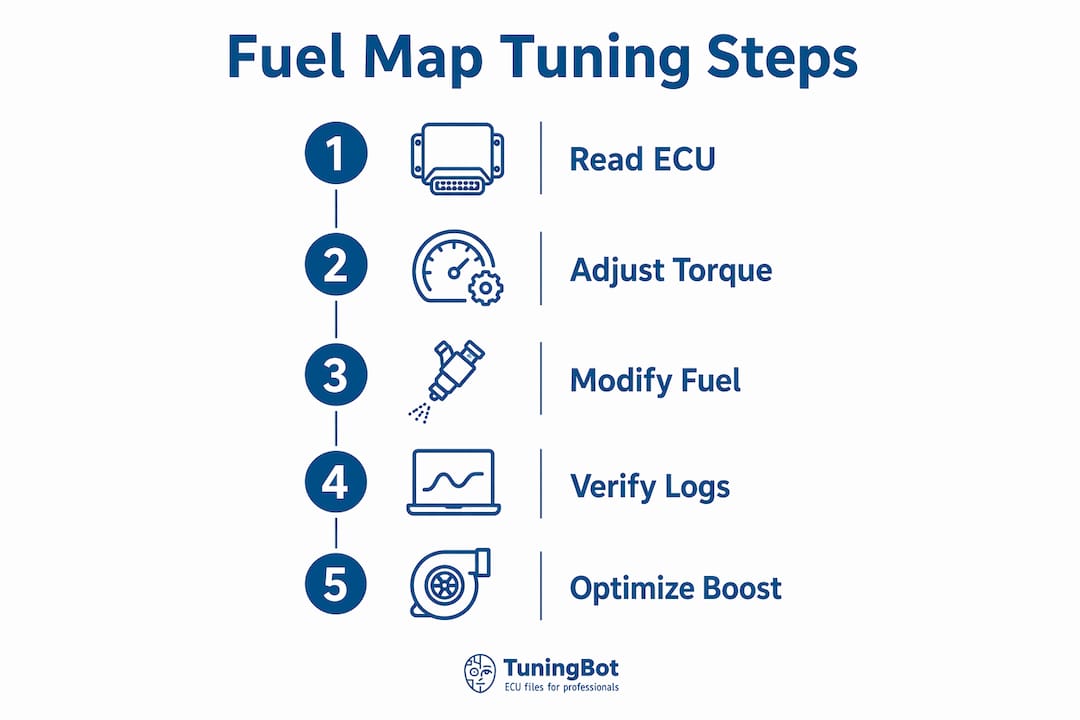
The ECU processes these maps in a defined sequence. The Driver’s Wish map converts throttle input into a torque request. The Torque Limiter caps that request based on mechanical and safety thresholds. The Fuel Mass converter (FMTC) translates the approved torque request into a target fuel mass per stroke. The Injection Duration map then converts that fuel mass into an actual injector open time based on rail pressure and injector flow rate. Tuning any one of these maps without accounting for the others creates mismatches the ECU cannot resolve cleanly.
Air management maps interact directly with fuel delivery. Boost target maps, MAF scaling, and VNT (variable nozzle turbine) control tables all affect how much air enters the cylinder. The ECU calculates the required fuel mass based on the air mass it measures or estimates. If the air model is wrong, the fuel calculation is wrong, regardless of how well the fuel maps are set.
Consejo profesional: Before editing any fuel map, read the full ECU map set and identify the torque chain. Changing injection duration without adjusting the FMTC or torque limiter will cause the ECU to hit a cap and revert to a safe default, making your changes invisible at the wheel.
What are the benefits and goals of fuel map tuning?
Fuel map tuning balances enrichment under high load for power and leaning during cruising for economy. That single principle drives most of what tuners do with fuel calibration. The specific goals vary by application, but they fall into a consistent set of categories.
- Power increase. Enriching the mixture under full load provides more fuel for combustion, raising torque output. This is the primary goal in Stage 1 and Stage 2 performance tunes.
- Fuel economy improvement. Leaning the mixture at part throttle and cruise RPM reduces fuel consumption without affecting drivability. A well-calibrated remap affects fuel consumption measurably in real-world driving cycles.
- Respuesta del acelerador. Adjusting the Driver’s Wish map and the low-load fuel tables sharpens or smooths pedal response depending on the driver’s preference.
- Emissions compliance. Calibrating mixture at idle and light load keeps exhaust gas composition within regulatory limits. This matters for workshops operating in markets with periodic emissions testing.
- Adaptation to hardware changes. Larger injectors, upgraded turbos, and high-flow fuel pumps all change the relationship between commanded fuel and actual delivery. Fuel map tuning recalibrates the ECU to match the new hardware.
- Engine safety. Correct mixture calibration prevents detonation under load and protects pistons, rings, and bearings from thermal stress caused by a lean condition.
The balance between goals 1 and 6 defines the quality of a tune. Pushing fuel for maximum power without respecting mechanical limits produces short-term gains and long-term failures.
What tools and techniques do tuners use for fuel map tuning?
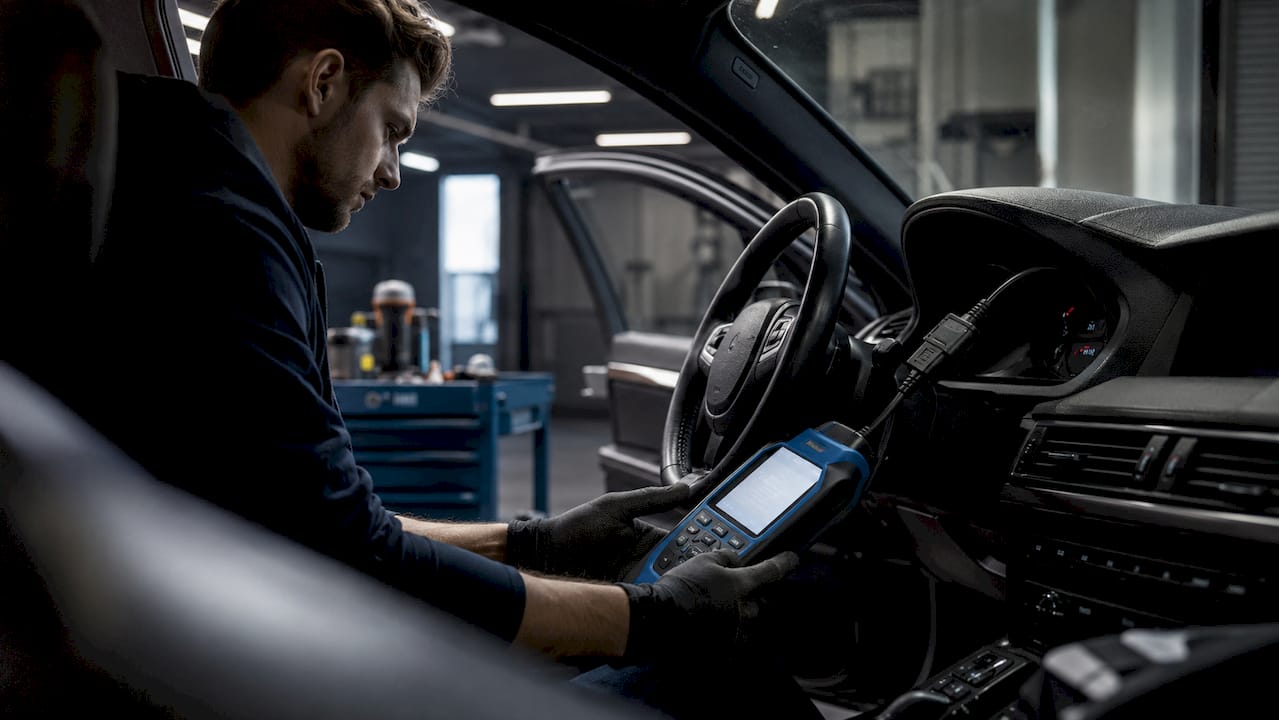
Fuel map editors like WinOLS allow precise modification of fuel injection maps through a graphical interface. Tuners read the existing binary from the ECU, identify the relevant maps, adjust cell values, and flash the modified file back. The workflow depends on the hardware interface and the ECU type, but the core steps are consistent across platforms.
Common tools and techniques in professional fuel map tuning include:
- ECU reading hardware. Tools like Alientech KESS3, AutoTuner, Magic Motorsport, CMD, Dimsport, and PCMFlash read and write ECU binaries via OBD-II port or direct bench connection. The choice of tool depends on ECU family and access method.
- Map editing software. WinOLS and similar editors display fuel maps as 3D graphs and spreadsheet tables. Tuners adjust individual cells or apply mathematical operations across a map axis.
- Data logging. Logging lambda (wideband O2), boost pressure, MAF voltage, and injector duty cycle during a road or dyno run validates whether the ECU is delivering the commanded fuel mass.
- Dyno testing. A rolling road or engine dyno measures torque and power output at each RPM point, confirming that fuel map changes produce the expected results.
- Flash tuning vs. piggyback tuning. Flash tuning overwrites ECU maps through the OBD-II port. Piggyback systems intercept and modify sensor signals in real time without rewriting the ECU binary. Flash tuning gives full control over the map set. Piggyback systems are limited to what the intercepted signals can influence.
Consejo profesional: Always tune in stages. Adjust the torque request chain first, verify with a data log, then move to injection duration. Skipping verification between stages compounds errors and makes root cause analysis nearly impossible.
For turbo applications, turbo map optimization requires coordinating boost targets, fuel mass, and ignition advance together, not as separate tasks.
What are the common challenges and mistakes in fuel map tuning?
Incorrect fuel map adjustments cause over-enrichment or lean conditions that damage the engine or produce poor drivability. Most tuning errors trace back to a misunderstanding of ECU map interdependencies rather than simple arithmetic mistakes.
The most frequent mistakes include:
- Editing maps out of sequence. Raising injection duration without first raising the FMTC target causes the ECU to cap fuel delivery at the original torque limit. The tune appears to do nothing, and the tuner adds more fuel, creating a dangerous condition when the cap is eventually removed.
- Ignoring air management. Over-enrichment in gasoline engines leads to excessive fuel consumption and pollution. In diesels, excess fuel causes black smoke and drivetrain stress. Both result from failing to match fuel delivery to actual air mass.
- Misreading injector scaling. Aftermarket injectors with different flow rates require rescaling the injector characterization maps. Applying a fuel mass change without correcting injector scaling delivers the wrong physical quantity of fuel regardless of the map value.
- Skipping knock control review. Advancing ignition to extract power without verifying knock sensor thresholds and retard maps leaves the engine unprotected under detonation conditions.
- Exceeding mechanical torque limits. The torque limiter exists to protect the drivetrain. Removing it entirely without understanding the physical limits of the clutch, gearbox, and driveshafts causes mechanical failures that no fuel map can fix.
Reviewing common ECU tuning errors before starting a new platform is a standard practice in professional workshops. It saves time and prevents expensive engine damage.
How does fuel map tuning vary across engine types and ECUs?
Gasoline ECUs commonly use closed-loop lambda control during many operating conditions, but may switch to richer targets under high load for knock and component protection. Diesel ECUs also use feedback and model-based control; they are not purely open-loop systems.
The map sequence and physics-based logic remain consistent across ECU families including Bosch, Siemens, and Denso. The map names and axis labels differ, but the underlying control structure is the same. A tuner who understands the torque chain on a Bosch EDC17 can apply the same logic to a Siemens PCR2.1 or a Denso SH72546 with appropriate map identification.
| Tuning priority | Gasoline ECU | Diesel ECU |
|---|---|---|
| Primary fuel control | Lambda target and injector pulse width | Fuel mass per stroke and rail pressure |
| Closed-loop feedback | Lambda feedback plus temperature, knock and fuel-pressure corrections | Airflow, lambda where fitted, rail-pressure and smoke-control feedback |
| Torque chain entry point | Driver’s Wish to torque request | Driver demand through torque model to fuel quantity |
| Boost interaction | MAP/MAF scaling and boost target | VNT position and boost target |
| Key safety limit | Knock retard and lambda protection | Smoke limiter and torque cap |
Naturally aspirated gasoline engines have fewer interacting maps than turbocharged diesels. The absence of a boost control loop simplifies the air model, but ignition timing interaction with fuel enrichment remains critical. Turbocharged gasoline engines sit between the two in complexity, requiring coordination of boost, fuel, and ignition maps simultaneously. Understanding ECU identification before starting any calibration work confirms which map set applies to the specific hardware variant on the bench.
For tuners working across multiple platforms, pairing fuel calibration knowledge with performance hardware understanding gives a clearer picture of how mechanical changes interact with ECU calibration targets.
Puntos Clave
Fuel map tuning requires modifying the ECU’s torque chain, fuel mass tables, and injection duration maps in sequence to achieve safe, measurable gains in power and efficiency.
| Punto | Detalles |
|---|---|
| Fuel maps control mixture | ECU lookup tables set fuel quantity at every RPM and load point, directly affecting power and economy. |
| Map sequence matters | Editing injection duration without adjusting the FMTC or torque limiter causes the ECU to cap fuel delivery. |
| Air management is inseparable | Boost targets, MAF scaling, and VNT maps must align with fuel mass targets for accurate delivery. |
| Diesel and gasoline differ | Diesel ECUs use fuel mass per stroke and rail pressure; gasoline ECUs use lambda feedback and pulse width. |
| Staged verification prevents damage | Data logging and dyno validation after each tuning stage catches errors before they cause engine failures. |
The part most tuners underestimate
The most common gap we see in tuning work is not a lack of software skill. It is a lack of ECU physics knowledge. Tuners who understand that the ECU is a physics model, not a collection of independent number tables, make fewer errors and produce better results. The Driver’s Wish map does not directly command fuel. It commands torque. The ECU then calculates what fuel mass achieves that torque given current air mass, temperature, and rail pressure. Changing a number in the injection duration map without understanding where that number sits in the calculation chain is the single most common source of tuning failures we encounter.
The second underestimated factor is verification. A tune that looks correct in the software is not a verified tune. Lambda logs, boost traces, and dyno pulls are not optional steps for cautious tuners. They are the only way to confirm that the ECU is executing what the calibration file instructs. We have reviewed files from workshops where the injection duration was raised correctly but the torque limiter was never touched, meaning the engine never saw the change under load. The dyno would have caught that in one pull.
Reliable tools and a structured workflow matter more than the specific software platform. TuningBot’s calibration resources and engineer support exist precisely to give workshops a structured starting point on unfamiliar ECU families.
— Equipo Técnico de TuningBot
TuningBot’s professional fuel-map calibration workflow
TuningBot supplies professionally calibrated ECU files for workshops working across Bosch, Siemens, Denso, Delphi, Marelli and Continental platforms. Fuel calibration is developed as part of the complete torque, air and protection strategy rather than as an isolated injection-table edit.
Before ordering, workshops can verify Cobertura del servicio ECU, repasa la Lista de Precios Pública y busca las disponibles Servicios ECU.
The original ECU file can then be submitted through Reprograma tu archivo without purchasing prepaid credits. TuningBot supports professional tools including Alientech KESS3, AutoTuner, Magic Motorsport, CMD, Dimsport and PCMFlash.
Para obtener orientación técnica relacionada, consulta la turbo map optimization guide, el Guía sobre los errores más comunes de la ECU tuning y las Guía de identificación ECU.
PREGUNTAS FRECUENTES
What is fuel map tuning in simple terms?
Fuel map tuning is the process of modifying the fuel injection tables in an ECU to change how much fuel the engine receives at different RPM and load points. The goal is to improve power, fuel economy, or both, depending on the application.
How does fuel mapping work inside the ECU?
The ECU references multi-dimensional lookup tables to determine fuel quantity, injection duration, and torque output for every operating condition. Changing maps out of sequence risks engine damage or causes the ECU to hit a torque or fuel limit and revert to a safe default.
What is the difference between flash tuning and piggyback tuning?
Flash tuning rewrites the ECU calibration through a supported OBD, Bench or Boot procedure. Piggyback systems alter selected sensor or actuator signals without providing full access to the ECU’s torque, fuel, air and protection strategies.
Can fuel map tuning improve fuel economy?
It can, but not by blindly leaning the mixture. Economy improvements come from coordinated torque demand, injection timing, ignition, boost, air management and enrichment strategies. The result also depends heavily on driving behavior.
Does fuel map tuning work the same way on diesel and gasoline engines?
No. Gasoline engines rely heavily on lambda and knock control, while diesel engines use torque-to-fuel models, rail pressure, injection timing, air mass and smoke-control strategies. Both use feedback and protection logic, but the maps and calibration priorities differ.