

 ItalianoIT
 DeutschDE
 EspañolES
 PortuguêsPT
 FrançaisFR
 РусскийRU
An ECU tuning workshop business model is defined as a structured automotive service operation that combines vehicle ECU calibration, file development, and workshop management to generate profit from remapping services. The core model integrates onsite bay work with remote file writing workflows, using tools like AutoTuner and Dimsport Genius alongside portal-based file services such as TuningBot to maximize throughput. Profitability in ECU tuning depends on service mix, technician utilization, and file turnaround speed. Workshops that build around hybrid remote file delivery consistently outperform traditional bay-only operations in both capacity and margin. This guide covers every operational and financial layer you need to plan, launch, or scale a custom ECU remapping business in 2026.
Table of Contents
- Operational workflows
- Startup and operating costs
- Revenue and profitability strategies
- Business model comparison
- Key takeaways
- The file service layer
- Scale with TuningBot file services
- FAQ
What are the primary operational workflows in ECU tuning workshops?
ECU tuning workshops operate through two core workflows: direct bay tuning and remote file writing. In direct bay tuning, a technician reads the ECU using a hardware tool, modifies calibration parameters onsite, and writes the updated file back to the vehicle. In remote file writing, the technician reads the ECU file in the bay, uploads it to a portal, and receives a calibrated file back within minutes without occupying the bay for the full job duration.
The remote file model has become the dominant workflow for high-volume shops. A structured online tuning file service workflow can deliver standard files through portal uploads, with auto-delivery when a matching calibration exists and manual intervention from file writers when it does not. This means a technician can read a file, send it, and move the vehicle out of the bay while the calibrated file arrives before the next job is complete.
Automated compatibility verification is a critical step before any file submission. Remote ECU remap platforms require compatibility checks before order acceptance to prevent wasted turnaround time on unsupported ECU configurations. TuningBot’s coverage matrix and structured submission workflow handle this verification step before the file enters the queue, reducing rejection rates and protecting bay time.
Key operational tools for a functioning ECU tuning workflow include:
- AutoTuner: No subscription fees, suited for light vehicle tuning across a broad ECU range
- Dimsport Genius: Optimized for heavy-duty 24V operations including trucks and agricultural machinery
- Alientech KESS3: Widely used for bench and OBD reading across Bosch, Continental, and Marelli ECUs
- PCMFlash: Cost-effective for specific Asian and European vehicle platforms
Pro Tip: Set up your file upload workflow before your first customer appointment. A technician who has never submitted a file through a portal will lose 30 minutes on the first job. Practice the submission process on a test file first.
How do startup and operating costs impact ECU tuning business feasibility?
Startup capital is the first filter for any ECU tuning business plan. Typical startup CAPEX for performance tuning businesses sits around $155,000, with operating cash requirements to survive early losses estimated near $793,000 and breakeven projected at approximately 4 to 5 months. These figures reflect a full-service setup with a dynamometer, multiple tuning tools, and a staffed workshop. A leaner mobile or file-only model reduces CAPEX significantly but limits service range.
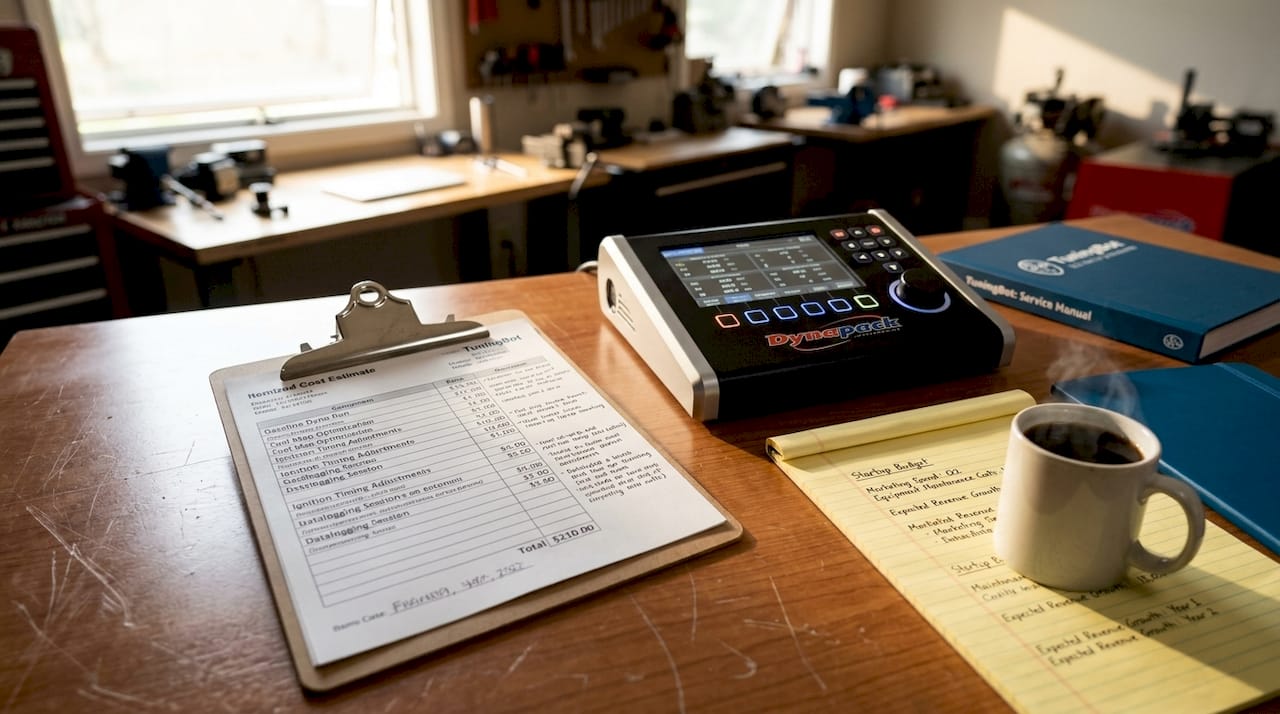
The equipment investment breakdown matters as much as the total figure. A chassis dynamometer from brands like Dynapack or Mustang Dynamometer costs between $30,000 and $80,000 depending on specification. Hardware tools such as AutoTuner and Dimsport Genius add $2,000 to $6,000 each. Software licenses, ECU file service subscriptions, and diagnostic platforms add recurring annual costs that must be factored into your operating budget from month one.
| Cost Category | Estimated Range | Notes |
|---|---|---|
| Chassis dynamometer | $30,000 to $80,000 | Dynapack, Mustang Dynamometer |
| ECU reading hardware | $2,000 to $6,000 per tool | AutoTuner, Dimsport Genius, KESS3 |
| Software licenses | $500 to $3,000/year | Varies by platform and ECU coverage |
| Workshop fit-out | $15,000 to $40,000 | Lift, electrical, ventilation |
| File service subscriptions | $100 to $500/month | Portal-based services like TuningBot |
Fixed overhead, including rent, insurance, and staff wages, creates the breakeven pressure every new workshop faces. Keeping fixed costs low in the first six months while building volume is the standard approach. Workshops that add remote file services early reduce the need for additional technician hours, which directly lowers the labor component of operating costs.
Pro Tip: Avoid purchasing “Master tool” setups that are unsupported by file services. A master tool with no portal integration forces you to develop every file in-house, which is only viable once you have a senior calibration engineer on staff.
What strategies maximize revenue and profitability in ECU tuning workshops?
Contribution margin is the primary financial metric for ECU tuning workshops. Performance tuning businesses model contribution margins at approximately 80%, with Year-1 EBITDA projections near $514,000 and effective hourly rates up to $200 for ECU remap work. An 80% contribution margin means that for every dollar of revenue above variable costs, $0.80 flows toward covering fixed overhead and generating profit. Reaching that margin requires tight control over file costs and labor time per job.
Pricing strategy directly determines how quickly a workshop crosses breakeven. A standard Stage 1 remap in the UK generates roughly £195 net profit per job at a retail price of £200 plus VAT, with a file cost of approximately £55 and under 45 minutes of technician time. At that rate, a workshop completing 10 Stage 1 remaps per week generates nearly £2,000 in weekly net profit from that service alone, before advanced services are added.
The four highest-impact strategies for maximizing profitability in ECU tuning are:
- Prioritize high-value services first. Custom dyno work at $180 per hour outperforms diagnostic jobs at $120 per hour. Schedule dyno sessions in dedicated blocks to prevent bay fragmentation.
- Use a dual-tool setup. Combining AutoTuner for light vehicles with Dimsport Genius for heavy-duty 24V work expands your service capacity without requiring a second technician.
- Add advanced services to every Stage 1 booking. DPF Off, EGR Off, AdBlue/SCR removal, and DSG/TCU tuning carry higher margins than base remaps and require minimal additional bay time when the ECU is already connected.
- Reduce file cost per unit through volume tiers. File service portals including TuningBot offer discount structures as submission volume increases, while the ECU tuning price list helps workshops keep unit economics transparent.
“Owner income is highly dependent on service mix, pricing, and technician utilization to exceed fixed overhead and operating costs. Healthy margins allow accelerated profit growth after breakeven.” — financialmodelslab.com
How do different ECU tuning business models compare?
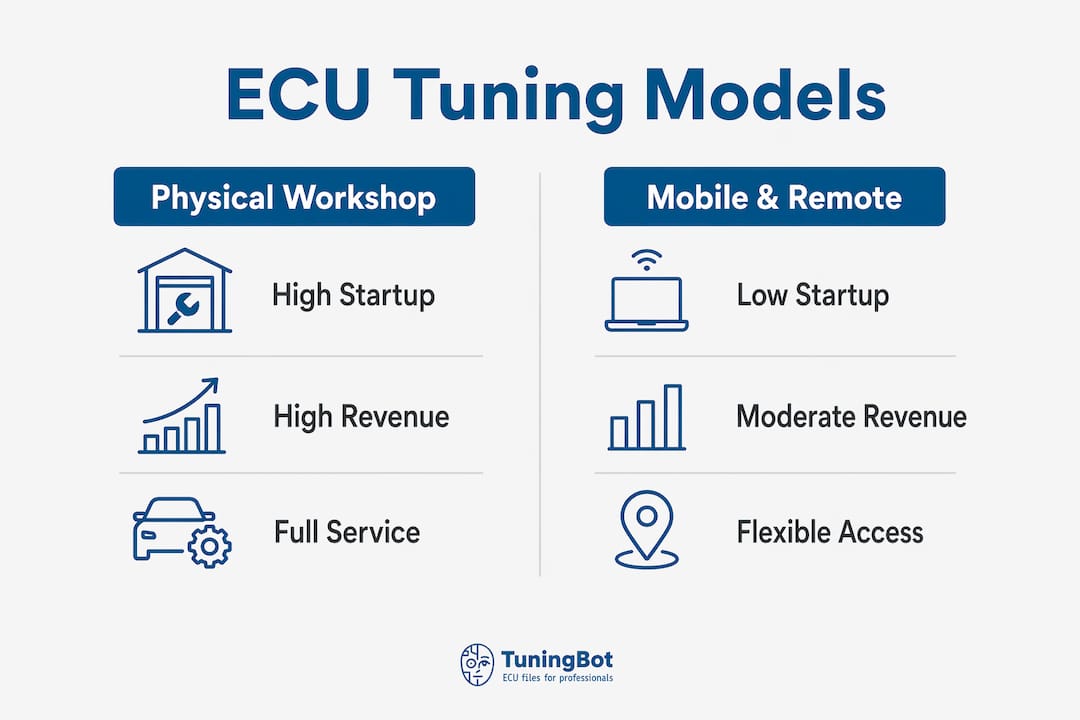
The three primary ECU tuning business models are the physical workshop, the mobile tuning operation, and the remote file service model. Each carries distinct capital requirements, revenue ceilings, and operational constraints. Choosing the right structure depends on your available capital, technical skill level, and target customer base.
The physical workshop model offers the highest revenue ceiling. A fully equipped shop with a dynamometer can handle Stage 1 through Stage 3 remaps, custom dyno calibration, and emissions-related services like DPF Off and AdBlue removal. The tradeoff is high fixed overhead and significant upfront CAPEX. This model suits entrepreneurs with access to $150,000 or more in startup capital and a local market with sufficient vehicle volume.
The mobile tuning model reduces CAPEX to hardware tools and a vehicle. A mobile operator using AutoTuner or KESS3 can perform OBD and bench reads at customer locations, upload files to a portal like TuningBot, and complete jobs without a fixed premises. Hybrid file automation reduces dependency on long bay occupancy by delivering standard files rapidly through portal automation, which is equally applicable to mobile operators working from a van.
| Model | Startup Cost | Revenue Ceiling | Best For |
|---|---|---|---|
| Physical workshop | $100,000 to $200,000+ | High (dyno, advanced services) | Established markets, high volume |
| Mobile tuning | $5,000 to $20,000 | Medium (OBD and bench only) | Low-overhead entry, rural markets |
| Remote file service | $2,000 to $8,000 | Scalable (volume-dependent) | B2B file supply, workshop networks |
| Hybrid (bay + portal) | $30,000 to $100,000 | High with lower overhead | Most workshops in 2026 |
The hybrid model, combining physical bay access with portal-based file writing, is the most practical structure for most workshops in 2026. It preserves the ability to perform advanced onsite work while offloading standard file development to services like TuningBot, freeing technician time for higher-value tasks. Workshops using the ECU Service Coverage matrix from TuningBot can check supported ECU and service combinations before committing bay time.
Key takeaways
A profitable ECU tuning workshop business model requires a hybrid operational structure that combines onsite bay capability with portal-based file services, controlled startup costs, and a service mix weighted toward high-margin calibration work.
| Point | Details |
|---|---|
| Hybrid model is the standard | Combining bay work with portal file services maximizes throughput and reduces technician idle time. |
| Startup CAPEX starts at $155K | Full-service workshops require significant capital; mobile and file-only models reduce this substantially. |
| 80% contribution margin is achievable | Tight file cost control and high-value service prioritization drive margins above the 80% threshold. |
| Dual-tool setups expand capacity | Pairing AutoTuner with Dimsport Genius covers both light vehicle and heavy-duty 24V tuning segments. |
| Compatibility checks protect bay time | Pre-order ECU verification through platforms like TuningBot prevents wasted turnaround on unsupported files. |
Why the file service layer is the most underrated part of your business model
Most workshops spend the majority of their planning time on equipment selection and pricing. The file service layer, meaning which portal you use, how fast it delivers, and how wide its ECU coverage is, gets treated as an afterthought. That is a structural mistake.
I have seen workshops invest in premium hardware and then route files through unreliable or poorly supported portals. The result is delayed turnarounds, customer complaints, and technicians standing idle waiting for files. The hardware is only as productive as the file service behind it. A workshop running AutoTuner with a well-integrated portal like TuningBot, which expanded its ECU coverage matrix by 837 solutions in May 2026, will consistently outperform a shop with better hardware and a slower file pipeline.
The other underrated factor is the cost of common fault patterns after poor tuning at the workflow level. Submitting files without compatibility verification, using unsupported master tools, or skipping structured support tickets when a file has issues all create compounding delays that erode the margin advantage ECU tuning offers. Automation and structured workflows are not optional extras. They are the operational foundation of a scalable workshop.
— TuningBot Technical Team
Scale your workshop with TuningBot’s professional file services
TuningBot provides ECU tuning workshops with direct access to professionally calibrated remapping files across all major ECU and TCU platforms, including Bosch, Continental, Delphi, Marelli, and Denso. No registration or prepaid credits are required to submit a file, which removes the friction that slows down high-volume operations.
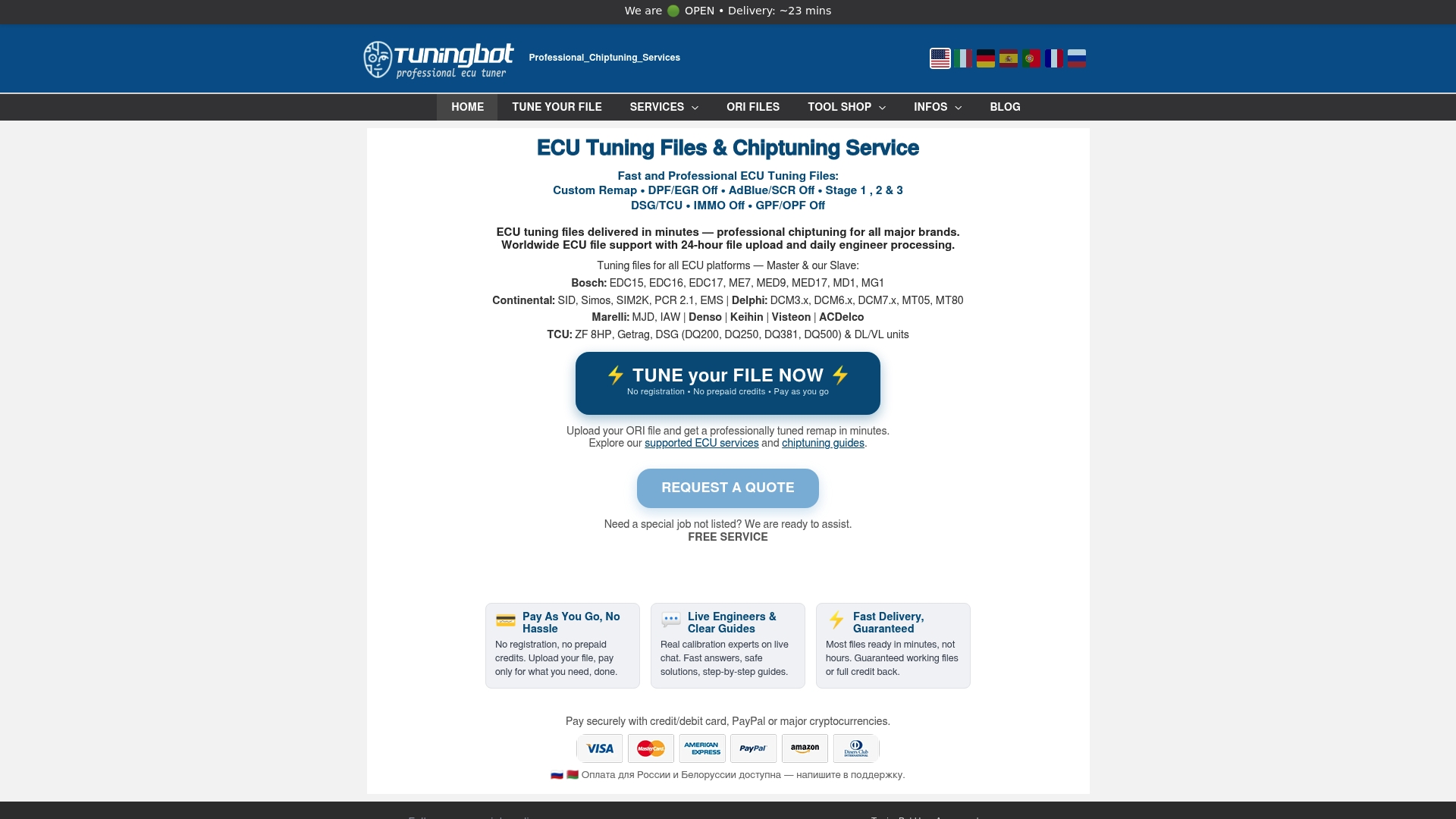
The ECU Service Coverage matrix helps workshops confirm supported ECU families and available solutions before submitting files. Workshops using TuningBot benefit from automated compatibility verification before submission, structured support ticket handling, and fast file delivery that keeps bay occupancy low. Whether you are running a physical workshop, a mobile operation, or a hybrid model, TuningBot’s online tuning file workflow integrates directly into your existing process. Submit your first file at Tune Your File and see the turnaround difference.
FAQ
What is an ECU tuning workshop business model?
An ECU tuning workshop business model is a structured automotive service operation that generates revenue from vehicle ECU calibration, remapping, and related services. It combines onsite bay work, hardware tools, and file service portals to deliver Stage 1 through Stage 3 remaps and advanced emissions or performance modifications.
How much does it cost to start an ECU tuning business?
Startup CAPEX for performance tuning businesses is approximately $155,000 for a full-service setup, with operating cash needs near $793,000 and breakeven at around 4 to 5 months. Mobile and file-only models can launch for $5,000 to $20,000.
What profit margin can an ECU tuning workshop expect?
Contribution margins of approximately 80% are achievable in performance tuning, with effective hourly rates up to $200 for ECU remap work. Margins improve as volume increases and file costs decrease through portal discount tiers.
What tools do I need to start custom ECU remapping?
The minimum setup requires an ECU reading tool such as AutoTuner, Alientech KESS3, or Dimsport Genius, plus a file service portal subscription for calibrated file delivery. A chassis dynamometer is required for custom dyno tuning but is not necessary for standard Stage 1 remapping.
How does a remote file service improve workshop profitability?
Remote file services reduce bay occupancy time by delivering calibrated files in under 10 minutes via portal upload, allowing technicians to process more vehicles per day. Portal automation increases workshop throughput and capacity without requiring additional staff.