

 EnglishEN
 ItalianoIT
 EspañolES
 PortuguêsPT
 FrançaisFR
 РусскийRU

A gear shift optimization file is a modified TCU (or combined ECU/TCU) calibration that changes when and how the transmission shifts: shift schedules, shift timing, clutch pressure behavior, torque handling and kickdown response. For a workshop, the file is only as good as the identification work before it and the logging after it. We deliver custom TCU calibrations for workshops that read the original file with their own tools, and this article covers the technical sequence we consider necessary for a shift file to be safe to write and worth keeping.
TL;DR
- Shift optimization changes shift schedules, shift time targets, pressure and torque-reduction behavior, and kickdown. It does not replace a matching engine calibration.
- Compatibility is decided by the exact TCU part number, hardware and software identification, processor, memory region and checksum procedure, never by gearbox name or file size.
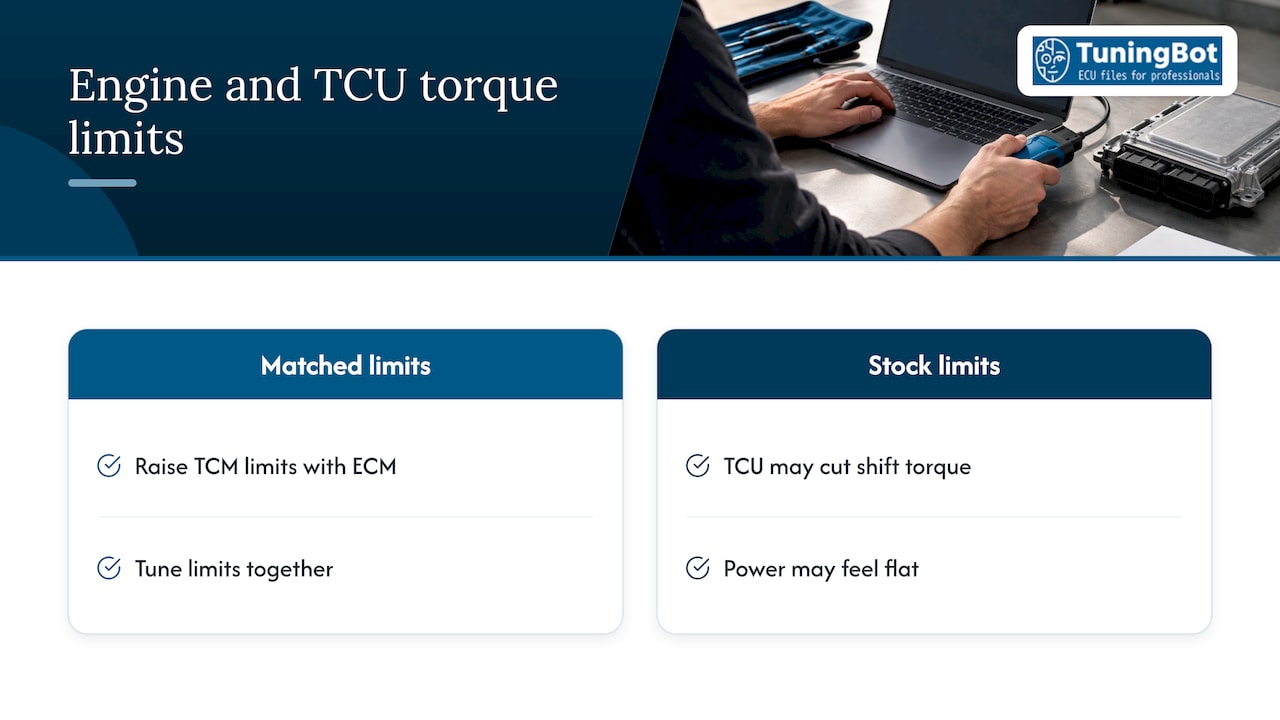
- TCU torque limits must be raised together with the engine tune, otherwise the TCU limits engine torque.
- Validate by logging before and after, with controlled road tests and attention to adaptations and temperature.
- Unser Preisliste covers Full Gearbox Tuning at 49.99 EUR per file.
Inhaltsverzeichnis
- What a shift optimization file actually modifies
- Torque handling: the parameter that limits results
- Compatibility: confirm before you write
- Read, modify, checksum, write
- Adaptation after flashing
- Validating results with logging
- Perspektive
- Ordering a gearbox file
- FAQ
- Quellen
What a shift optimization file actually modifies
The transmission control unit decides gear changes from a set of maps and functions. The main ones are shift schedules, forced up- and downshifts, shift time targets, pressure crossovers, torque reductions and kickdown, as EcuTek’s VW DQ250 documentation lists them for dual-clutch units.
The shift schedule is the core. In EcuTek’s RE7R guide, the shift point is the vehicle speed or RPM at which the TCM requests the next gear. Maps are organized by shifter position (Drive or Manual), by drive mode (Normal, Eco, Snow, Sport, Intermediate) and by a 14×7 array of current and demanded gear pairs. Each map holds vehicle-speed and accelerator-pedal thresholds for upshifts and downshifts. Raising the vehicle-speed threshold at a given pedal position raises the RPM at which the box shifts.
That structure explains what a file can and cannot do. It can move shift points, make Sport mode hold gears longer, or sharpen response. Each change is bounded by what the hardware allows: clutch capacity, pressure control and the base gear ratios.
Inputs the TCU relies on
Shift behavior depends on signals, not only maps. Syvecs’ 8HP quick-start manual lists the inputs required for correct operation: RPM, vehicle speed (with tire size and final drive), MAP, throttle position, pedal position, torque actual, potential and demand, brake input, coolant and air temperatures and paddles. It also says to check all values before connecting the TCM to the gearbox. For a workshop this is a reminder that a changed tire size, a swapped engine calibration or an altered torque signal changes what the TCU sees.
Torque handling: the parameter that limits results
On DSG units, EcuTek states that the most important parameter is the input torque the TCM receives over CAN from the engine control module. Its guidance is that TCM torque limits must be raised together with the ECM tune, or the TCU will limit engine torque and reduce power.
This is the most common reason a Stage 1 car feels flat or inconsistent after a good engine file. If you tune the engine and leave the gearbox calibration at stock limits, the gearbox may cut torque during shifts or under load. Our guides on DSG tuning, shifts and torque limits and on 6HP torque signals, adaptations and validation go through how those limits interact with the engine file.
Compatibility: confirm before you write
Most failed TCU jobs trace back to identification, not calibration. Several tool vendors’ programming guides agree on the same checklist: exact TCU manufacturer and complete part number, hardware number and revision, software or calibration ID, processor family, target memory region, file format and size, file source, intended application and checksum requirements. Two guides (KT200II und ECUHELP) both state that a similar gearbox name or matching file size does not prove a file fits, and that a valid checksum does not prove suitability.
A practical routine:
- Photograph the controller label before removal or reading, and record the full part number.
- Read hardware and software identification through the tool, and compare it with the label.
- Confirm that your tool supports this exact controller and the read or write method you intend to use.
- Confirm the memory region in the file matches what you will write.
- Stop if anything is uncertain and investigate before writing.
Support for one TCU variant does not establish support for every controller in the same transmission family. This also applies to base maps: the TurboLamik 8HP reference warns that the gear-ratio table must match the hardware and must not be edited, because base maps are not interchangeable between boxes, for example 8HP50 against other 8HP variants. Our file service works from the original file you upload, and availability depends on ECU family, software version, reading method and technical compatibility. Our ZF TCU tuning overview und DQ381 calibration checks show what identification looks like on specific families.
Why swapping calibration IDs is a trap
It is tempting to borrow a different calibration ID because it carries a more attractive shift schedule. EcuTek’s RE7R guide cautions that, even where the processor offers some cross-compatibility, changing calibration IDs has been known to brick TCUs completely, and recommends checks and tests first. Edit the schedule inside the correct calibration instead of moving to another one.
Read, modify, checksum, write
The workflow for a shift file follows the same discipline as an engine file, with extra weight on backup and identification.
| Stage | What to do | Where it goes wrong |
|---|---|---|
| Read | Read the full original with a supported tool, in the mode the tool specifies | Partial or wrong-region reads, unrecorded identification |
| Sicherung | Keep the untouched original and label it with the part and software numbers | Overwriting the only original |
| Modify | Request or apply shift schedule, torque and pressure changes for that exact software | Using a file from a similar but different calibration |
| Checksum | Correct checksums after modification | Treating a valid checksum as proof of compatibility |
| Write | Stable power supply, correct protocol, no interruption | Voltage drop, wrong protocol selected |
| Validate | Clear faults, log, road test | Skipping adaptation and logging |
We supply checksum correction as a separate service at 29.99 EUR per file when your tool does not handle it, and Full Gearbox Tuning at 49.99 EUR per file. Most standard files are delivered in approximately 15 to 20 minutes during published operating hours, depending on complexity and workload.
Adaptation after flashing
A TCU learns clutch fill points, pressure behavior and shift characteristics over time. After a new calibration, those learned values may no longer suit the changed targets. Our DSG TCU procedure for flashing and adaptation describes the sequence for dual-clutch units. Follow the platform’s adaptation routine, then drive in a way that lets the unit relearn: mixed light and moderate loads, warm fluid, and several shifts through each gear pair, before judging quality.
Validating results with logging
A shift file is validated by data, not by feel alone. Log the same route and conditions before and after the change, and compare what the TCU commanded with what happened.
Useful channels, where your tool exposes them:
- Vehicle speed, engine RPM, pedal position and current and target gear
- Torque demand and actual torque, including any torque reduction during shifts
- Transmission fluid temperature
- Clutch or converter slip, where available
- Fault codes and adaptation values
Test in steps. First, light-throttle upshifts and coasting downshifts, which is where harsh transitions show up most clearly. Then part throttle, then kickdown, then full load. Repeat at warm and cold fluid temperatures. Harsh downshifts on coasting or braking, a pattern that tuners report after changing related functions, are a sign to revisit downshift thresholds and pressure targets.
For components, keep changes in proportion to the clutch and pressure capacity of the unit and its condition. A worn clutch pack will not hold a calibration that a healthy one does. Check for stored DTCs and fluid condition before you calibrate, not after a complaint.
Perspektive
Most shift complaints we see described by workshops come down to two issues: a gearbox calibration that was never matched to the engine tune, and a file chosen by gearbox name instead of by identification. Our approach is to treat the TCU as part of the powertrain calibration, with torque limits, shift schedules and pressure behavior set together for the exact software version in the file.
That is why we work from the original file you upload and why our calibration engineers handle gearbox files as custom work. Availability depends on the ECU family, software version, reading method and technical compatibility, and we state that openly. Our shift map tuning checks set out the calibration review we apply.
TuningBot Technical Team
Ordering a gearbox file
For a gear shift optimization file, upload the original TCU or ECU file, select Full Gearbox Tuning and add services such as checksum correction where needed. Standard orders need no mandatory registration, pricing is per file, and prepaid credits are optional. See the Preisliste for the current services, and our tuning overview for how the service works. Our technical support portal is available for questions about a specific file. Emissions-related modifications are intended only for applications permitted by applicable laws, such as off-road or motorsport use where that applies.
FAQ
What is a gear shift optimization file?
It is a modified TCU calibration that changes shift schedules, shift timing, pressure and torque behavior, and kickdown response. It is written to the transmission controller with a compatible tool after the original has been read and backed up.
Do I need to tune the engine and gearbox together?
Yes, in most cases where engine torque changes. On DSG units the TCM torque limits must be raised with the engine tune, or the TCU limits engine torque and reduces power. Our guide to TCU remapping explains the relationship.
Is a valid checksum enough to confirm a file fits?
No. Tool vendors’ guides state that a valid checksum, or a matching file size, does not prove the file suits the target controller. Confirm part number, hardware, software ID, processor and memory region first.
How should I verify the result after writing?
Log the same route before and after, clear faults, allow adaptation to run, and test from light-throttle shifts up to kickdown at several fluid temperatures. Compare commanded and actual gear, torque and temperature.
Quellen
- EcuTek RE7R Tuning Guide
- EcuTek VW AG DQ250 Transmission tuning
- Syvecs 8HP Quick Start Manual
- TurboLamik 8HP Transmission Cal. parameters
- KT200II TCU Programming Guide
- ECUHELP TCU Programming: Transmission Module Repair