

 ItalianoIT
 DeutschDE
 EspañolES
 PortuguêsPT
 FrançaisFR
 РусскийRU
E85 conversion remapping requires more than increasing injector pulse width. A professional workflow must assess actual ethanol content, fuel-system capacity, material compatibility, cold-start behavior, torque modelling, knock control and legal use. The correct strategy may be a fixed ethanol calibration, a flex-fuel system with a verified ethanol-content signal, or no conversion at all if the vehicle hardware cannot support the required flow and pressure.
What changes inside the ECU during an E85 remap?
An E85 calibration can affect injector characterization, fuel-mass modelling, lambda targets, ignition, cold-start and warm-up strategies, torque monitoring and protection functions. The exact map set varies by ECU and engine.
- Fuel-mass and injector scaling: recalibrate according to actual ethanol content, injector characterization and fuel-pressure model.
- Injector characterization: update deadtime, flow and pressure compensation only when injector data requires it.
- Ignition timing: optimize from measured knock response; higher ethanol content does not justify automatic timing advance.
- Lambda targets: calibrate in lambda rather than relying on gasoline-equivalent AFR numbers.
- Cold-start and warm-up: validate across the ambient temperatures the vehicle will actually encounter.
- Knock control: retain functional protection and verify thresholds rather than weakening safeguards.
Key principle: an ethanol conversion is a coordinated engine-calibration and fuel-system project, not a single-table edit.
What should the workshop verify first?
Do not begin an ethanol conversion on a vehicle with unresolved mechanical, fueling, ignition or diagnostic faults. Higher fuel demand and cold-start sensitivity can expose weaknesses quickly.
- Compression, leak-down and general engine health where appropriate
- Stored, pending and historical DTCs
- Low- and high-pressure fuel-system performance
- Injector capacity and available control-time headroom
- Ignition-system condition
- Fuel-contact material compatibility
- Original ECU file and exact ECU identification
Before calibration, review the vehicle’s wider hardware condition. The external E6 Carbon performance build guide is retained as a general supporting reference, although its recommendations still need to be verified for the exact vehicle.

Fixed E85 map vs. flex-fuel strategy
Pump-labelled E85 can vary by season and region. A fixed calibration must be based on measured fuel content and a controlled operating range. A flex-fuel strategy is preferable only when the ECU can use a reliable ethanol-content signal and the blend interpolation is fully calibrated.
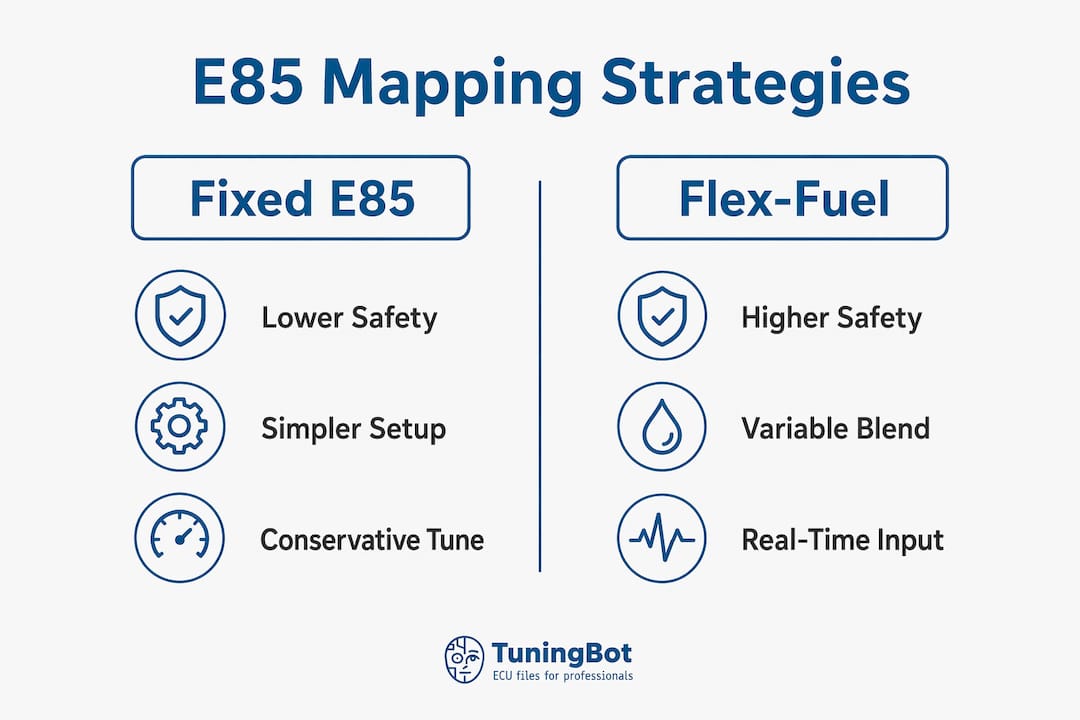
| Criterion | Fixed ethanol calibration | Flex-fuel calibration |
|---|---|---|
| Fuel requirement | Fuel content must remain within the calibrated range | Can adapt when a reliable ethanol-content signal is available |
| Complexity | Lower, but customer fueling discipline is critical | Higher; requires sensor integration and blend interpolation |
| Risk | Incorrect blend can create fueling and ignition mismatch | Sensor, wiring or interpolation faults must be diagnosed safely |
| Best use | Controlled fuel supply or competition environment | Street use with variable blends where the ECU supports it correctly |
Do not use universal wide-open-throttle lambda targets based only on whether the engine is naturally aspirated or turbocharged. Safe targets depend on combustion design, boost, exhaust temperature, fuel pressure, knock response and component limits.
When is a remap alone not enough?
Software cannot compensate for a fuel system that cannot maintain the required flow and pressure. Ethanol blends generally require greater fuel mass than gasoline for equivalent lambda, but the exact increase depends on actual ethanol content, stoichiometric ratio and target output.
- Injectors: calculate and log injector control at target load using the metric appropriate to the ECU.
- Fuel pumps: verify low- and high-pressure stability at operating temperature and full load.
- Fuel lines and seals: verify compatibility with the intended blend; PTFE replacement is not universally mandatory.
- Ethanol-content sensor: use a compatible sensor and ECU input or validated CAN interface where flex-fuel requires it.
What should be logged and validated?
| Validation area | What to confirm |
|---|---|
| Lambda control | Commanded and measured lambda remain coherent through transient and steady load |
| Fuel pressure | Low- and high-pressure systems maintain required pressure under temperature and load |
| Injector capacity | Control time and available headroom remain appropriate for the injection system |
| Knock response | No repeatable abnormal knock pattern or excessive correction |
| Cold start and warm-up | Reliable starts and stable transition across expected ambient temperatures |
| Diagnostics | No new critical DTCs or disabled required monitors |
Validation can combine controlled dyno testing and legal road logging. Progress from low load to high load only after fuel pressure, lambda and knock behavior are confirmed. The track-day remap preparation guide provides an additional framework for structured high-load checks.
ECU file handling and checksum workflow
- Identify the exact ECU hardware and software version.
- Read or obtain the correct original or virtual file.
- Archive the original with VIN, ECU ID, date, tool and revision metadata.
- Calibrate the file for the defined ethanol strategy and hardware.
- Confirm checksum or integrity handling for the exact file format and write method.
- Write under stable conditions and perform post-write diagnostics and logging.
The ECU file checksum correction guide explains the general validation workflow. Raw, virtual, partial, encrypted and Master/Slave files may require different handling.
U.S. emissions and legal considerations
Alternative-fuel conversions can affect federal and state emissions compliance. Requirements depend on the vehicle, model year, intended use, jurisdiction and the exact conversion. Retaining the original file does not by itself make the conversion legal or restore certification status.
- Do not disable required emissions monitors or hardware on road vehicles.
- Document the conversion scope, fuel requirements and customer instructions.
- Check current federal and state requirements for the exact vehicle.
- Obtain qualified legal or compliance advice when certification or tampering rules may apply.
TuningBot E85 calibration support for workshops
TuningBot can support E85 and flex-fuel calibration requests where the exact ECU, file format and service are covered. The workshop should provide the original file, ECU identification, measured or intended ethanol range, hardware specification and target use.
Before ordering, workshops can check ECU Service Coverage, review the public Price List and browse the available ECU services.
The original file can be submitted through Tune Your File without prepaid credits. The workshop remains responsible for fuel-system suitability, writing, diagnostics, validation and legal compliance.
FAQ
What is an E85 conversion remap?
It is an ECU calibration adapted for a defined ethanol blend or a supported flex-fuel strategy. It must coordinate fueling, ignition, cold start, torque and protection functions.
Is a flex-fuel sensor always required?
No. It is not required for every fixed-blend calibration. For variable street fuel, a correctly integrated ethanol-content sensor is often preferable when the ECU and calibration support it.
What hardware upgrades are required?
No universal list applies. Verify injector capacity, pump flow, pressure control and material compatibility at the intended blend and power level.
Is an E85 remap legal in the United States?
Alternative-fuel conversions can affect emissions certification and anti-tampering rules. Obtain current qualified compliance advice for the exact vehicle and jurisdiction.