

 EnglishEN
 ItalianoIT
 DeutschDE
 EspañolES
 FrançaisFR
 РусскийRU
O que é um arquivo de remap? Arquivos de calibração da ECU explicados
Um remap file é um arquivo binário de software “modificado” que substitui ou sobrescreve os mapas de parâmetros calibrados de fábrica armazenados na ECU de um veículo, alterando diretamente a forma como o motor gerencia o fornecimento de combustível, o tempo de ignição, a pressão boost e os limites de torque. O termo “remap file” é uma abreviação amplamente utilizada no setor; a designação formal é “arquivo de calibração da ECU” ou “binário da ECU”. Compreender os remap files é fundamental para qualquer oficina ou profissional que trabalhe com plataformas como TuningBot, Alientech KESS3 ou AutoTuner, pois é no próprio arquivo que todas as decisões de ajuste estão contidas. Um arquivo mal elaborado danifica os motores. Um arquivo bem calibrado proporciona ganhos de desempenho mensuráveis e repetíveis.
O que é um remap file e em que ele difere da calibração padrão?
Um remap file é definido como uma versão modificada do binário original da ECU, contendo tabelas de consulta e mapas de controle ajustados que regem o comportamento do motor em toda a faixa operacional. A calibração padrão da ECU fornecida por fabricantes como Bosch, Continental ou Delphi é deliberadamente conservadora. Ela leva em conta as variações na qualidade do combustível nos mercados globais, as regulamentações de emissões e as tolerâncias mecânicas na extremidade inferior da faixa de produção. Isso significa que a maioria dos motores calibrados de fábrica deixa uma margem significativa de desempenho inexplorada.
O Processo de calibração do remap file Envolve a leitura do arquivo binário original da ECU, a identificação dos mapas específicos que controlam parâmetros como a quantidade de injeção de combustível, a pressão no trilho, os valores-alvo e o avanço da ignição, e, em seguida, a adaptação desses valores para atender ao objetivo do ajuste. O arquivo ajustado é gravado de volta na ECU por meio de uma ferramenta de programação, e Correção checksum é aplicado para evitar que a ECU rejeite os novos dados por estarem corrompidos. Sem os checksums corretos, a ECU se recusará a aceitar o arquivo ou entrará em estado de falha, tornando essa etapa imprescindível.

Os Remap files diferem dos módulos piggyback modules ou das caixas de ajuste plug-in, que interceptam os sinais dos sensores externamente. Um remap file opera nativamente dentro da ECU, o que significa que o sistema de gerenciamento do motor executa a lógica modificada diretamente, sem dependência de hardware externo.
Como funciona um remap file dentro de uma ECU?
A ECU contém centenas de mapas de parâmetros organizados como tabelas de consulta bidimensionais e tridimensionais. Cada tabela define como o motor responde a uma combinação específica de entradas, como rotação do motor em função da carga ou temperatura do líquido de arrefecimento em função do tempo de injeção. Um remap file ajusta os valores nessas tabelas para deslocar a curva de resposta do motor em direção ao objetivo de ajuste.
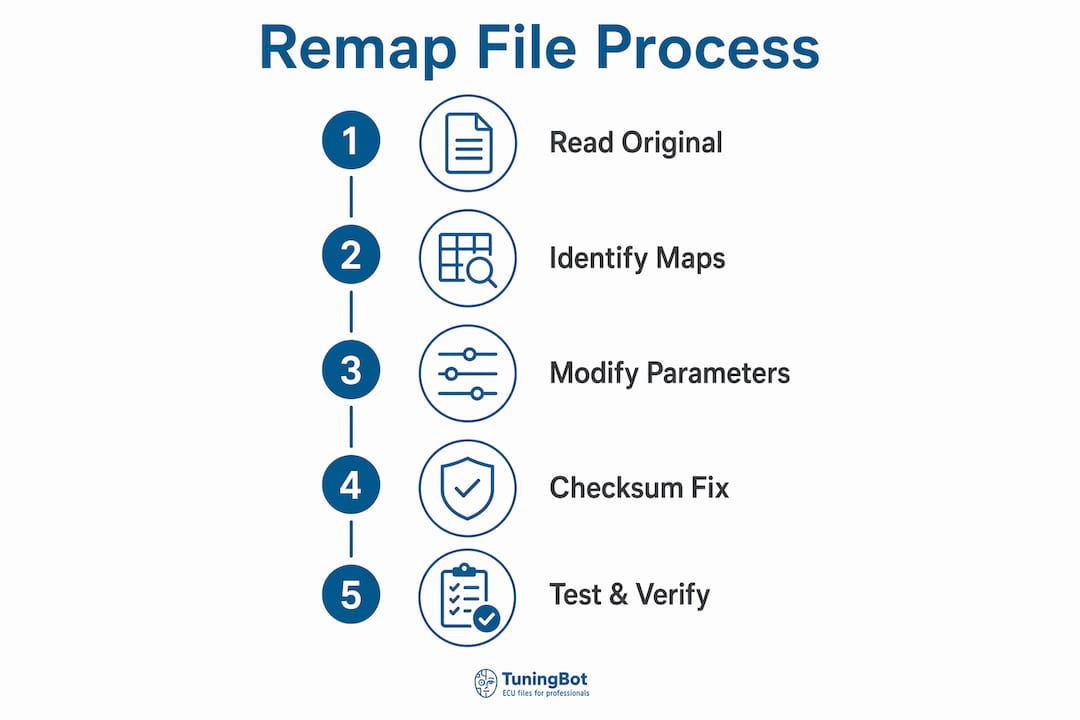
O fluxo de trabalho profissional remapping segue uma sequência estruturada:
- Ler o arquivo ECU original usando uma ferramenta de flashing compatível como a Alientech KESS3, Magic Motorsport ou CMD Flash, capturando o binário completo da memória da ECU.
- Identificar e modificar mapas-alvo dentro do sistema binário, utilizando um software de ajuste, ajustando as tabelas de pressão do boost, os mapas de injeção, os limitadores de torque e as curvas de sincronização da ignição para atingir a potência desejada.
- Aplicar a correção checksum para validar o binário modificado. A correção do arquivo checksum é fundamental para evitar erros na ECU e garantir a estabilidade após a reprogramação.
- Grave novamente o arquivo modificado para a ECU usando a mesma ferramenta de flashing ou uma compatível, completando o ciclo de reflash.
- Registrar dados em tempo real em diversas condições de carga para verificar que a nova calibração opera com segurança em toda a faixa de carga do motor.
Monitoramento de dados em tempo real monitoring Após o remapping, é fundamental verificar a segurança e o funcionamento correto do motor sob diferentes cargas. Negligenciar essa etapa é um dos erros mais comuns no setor e um caminho direto para danos ao motor.
Dica de Mestre: Sempre registre pelo menos três acelerações a todo o gás em toda a faixa de RPM após gravar um remap file. Uma única passagem não revela anomalias na injeção de combustível ou no boost que só aparecem sob carga sustentada.
Quais são os benefícios práticos e as aplicações comuns dos remap files?
Os Remap files proporcionam melhorias mensuráveis em três categorias principais: potência, eficiência de combustível e personalização específica para cada veículo. Os ganhos específicos dependem da plataforma do motor, do estado do hardware e do objetivo do ajuste, mas os mecanismos são consistentes em todas as aplicações.
Os principais benefícios que profissionais e entusiastas buscam incluem:
- Ganhos de potência e torque: O ajuste das metas de pressão do boost, dos mapas de injeção e das tabelas de gerenciamento de torque libera a margem de potência de fábrica incorporada aos motores a diesel e a gasolina turboalimentados. Um remap de Stage 1 em um motor a diesel turboalimentado moderno pode proporcionar aumentos de 20 a 30 por cento no torque máximo sem alterações de hardware.
- Otimização da eficiência de combustível: Os sistemas Economy remaps reduzem o consumo de combustível em aceleração parcial e otimizam o tempo de injeção para aumentar a eficiência da combustão. Motoristas que passam a maior parte do tempo com cargas leves costumam observar reduções mensuráveis no consumo de combustível após uma calibração voltada para a economia.
- Resposta do acelerador e dirigibilidade: Modificar mapas de aceleração e curvas de entrega de torque remove as falhas e hesitações incorporadas nas calibrações OEM para conformidade com as emissões, produzindo uma entrega de potência mais linear e responsiva.
- Personalização específica do veículo: Os Remap files podem ser personalizados para veículos específicos models e para atender às necessidades do motorista, a fim de otimizar o desempenho, a economia ou as emissões. Isso inclui a realização de atualizações de hardware, como intercoolers maiores, injetores aprimorados ou sistemas de escapamento de alto fluxo, que exigem recalibração para funcionar corretamente.
- Emissões e diagnósticos: modificações: As oficinas utilizam o remap files para realizar calibrações de desativação do DPF, do EGR e do AdBlue/SCR em veículos nos quais esses sistemas apresentaram falhas mecânicas, bem como para a remoção de códigos de falha (DTC) e procedimentos de desativação do IMMO.
Dica de Mestre: Quando um cliente instala uma atualização de hardware, como um turbo maior ou injetores de maior capacidade, a calibração de fábrica da ECU limita ativamente o benefício desse hardware. Uma calibração remap file adequadamente ajustada é o que transforma o investimento em hardware em desempenho real.
O verdadeiro poder da personalização no tuning automotivo vem precisamente dessa capacidade de adaptar a calibração ao estado específico do veículo, em vez de aplicar uma solução genérica.
Quais são os riscos e as limitações do uso de remap files?
Os Remap files apresentam riscos reais quando aplicados sem o conhecimento especializado adequado, sem testes ou sem uma avaliação do veículo. Compreender esses riscos é o que diferencia a calibração profissional da abordagem do tipo “carregar e partir”, que domina uma parte significativa do mercado.
- Estresse e durabilidade do motor: Motores remapeados podem enfrentar estresse mecânico adicional exigindo manutenção e monitoramento cuidadosos. Uma manutenção inadequada pode afetar negativamente a vida útil e a confiabilidade, caso não seja realizada por profissionais. Componentes que operam em altas temperaturas e com altos níveis de combustível exigem intervalos de manutenção mais curtos e inspeções mais frequentes.
- Risco de arquivo genérico: Aproximadamente 90% das ECUs tuners utilizam arquivos pré-configurados remap files em vez de calibrações personalizadas. Essa dependência generalizada de arquivos prontos para uso significa que a maioria dos veículos recebe uma calibração criada com base na média da plataforma, e não no motor específico em questão. Injetores desgastados, um DPF parcialmente entupido ou um vazamento não serão levados em conta em um arquivo genérico.
- Exposição legal e de seguro: As normas legais não proíbem o remapping, mas as seguradoras geralmente exigem a divulgação das modificações. Deixar de informar a seguradora sobre uma remap pode resultar na recusa do pedido de indenização após um acidente. Essa é uma responsabilidade que recai tanto sobre o proprietário do veículo quanto, em algumas jurisdições, sobre a oficina que realizou o serviço.
- ECU compatibilidade e erros de flash: Gravar um arquivo incorreto ou incompatível em uma ECU pode danificar a unidade de controle, exigindo recuperação em bancada ou a substituição da ECU. Esse risco aumenta significativamente ao usar arquivos de provedores não verificados.
“Muitos pensam, erroneamente, que as atualizações remap file são simples atualizações mágicas de software, mas, na verdade, são ajustes complexos dos parâmetros de fábrica, cuidadosamente otimizados por meio de testes.” Essa distinção é importante porque define a diferença entre uma calibração que melhora um veículo e outra que o danifica.
Como escolher um serviço remap file e garantir a qualidade
A escolha de um provedor de remap file exige a avaliação da transparência, do processo técnico e dos padrões de verificação pós-remap. O mercado apresenta um amplo espectro de qualidade, e a diferença de preço entre um arquivo genérico e um calibrado profissionalmente raramente reflete a diferença real de risco.
| Critérios | O que procurar |
|---|---|
| Transparência de arquivo | O provedor fornece uma cópia do arquivo modificado com um registro de modificação válido |
| Verificação de checksum | Confirmada a aplicação da correção checksum antes da entrega do arquivo |
| Testes pós-remap | Registro e verificação de dados em tempo real incluídos no serviço |
| Suporte à plataforma ECU | Cobre sua marca específica de ECU: Bosch, Continental, Delphi, Marelli, Denso, Siemens |
| Compatibilidade da ferramenta de flash | Ferramentas que você suporta: Alientech KESS3, AutoTuner, Magic Motorsport, Dimsport, PCMFlash |
Fornecer aos clientes uma cópia do arquivo modificado remap file após o ajuste é um padrão profissional reconhecido. Recusar-se a fornecer o arquivo ajustado é um sinal direto de trabalho de baixa qualidade ou produzido em massa. Qualquer serviço profissional deve ser capaz de mostrar exatamente o que foi alterado e por quê.
Algumas plataformas de remap de ECU oferecem portais seguros para o envio de arquivos originais da ECU e o recebimento de arquivos processados, com acompanhamento de pagamentos e status. Essa abordagem aprimora o gerenciamento de arquivos e a transparência tanto para a empresa quanto para seus clientes, criando um registro auditável de cada transação.
Dica de Mestre: Antes de aceitar um remap file preenchido, solicite que o original e o modificado sejam apresentados lado a lado. Um tuner legítimo mostrará os mapas específicos que foram alterados. Se não puderem ou não quiserem fazê-lo, considere isso uma resposta desqualificante.
Pontos-chave
Um remap file é um binário de ECU modificado que ajusta os mapas de parâmetros de fábrica para otimizar o desempenho do motor, e sua qualidade depende inteiramente do processo de calibração, da checksum integridade e da verificação pós-remap realizada posteriormente.
| Ponto | Detalhes |
|---|---|
| Definição de Remap file | Um arquivo binário da ECU modificado que substitui os mapas de parâmetros de fábrica que controlam o combustível, o boost e a ignição. |
| Correção de checksum é obrigatória | Sem os checksums corretos, a ECU rejeitará o arquivo modificado ou apresentará uma falha. |
| Arquivos genéricos carregam riscos mensuráveis | Cerca de 90% de tuners utilizam arquivos pré-criados que não levam em conta as condições específicas de cada veículo. |
| O registro de dados em tempo real é inegociável | Os registros pós-remap em diversas condições de carga confirmam que a calibração é segura e correta. |
| Transparência de arquivos protege a todos | Um serviço profissional sempre fornece o arquivo modificado e um registro claro das alterações realizadas. |
Por que os remap files são apenas o ponto de partida
Ao longo dos anos, analisei centenas de remap files, e a conclusão mais consistente é esta: o arquivo é o indicador menos confiável da qualidade do trabalho de ajuste. Um binário tecnicamente correto, com checksums adequados e mapas bem ajustados, ainda pode resultar em uma calibração perigosa se o tuner nunca tiver verificado se ela corresponde ao veículo real.
A dependência da indústria em arquivos genéricos não é segredo. O que mais surpreende os profissionais quando eles se deparam com os números reais pela primeira vez é o quão normalizado isso se tornou. Oficinas que construíram sua reputação em prazos rápidos e preços baixos são estruturalmente incentivadas a carregar um arquivo pré-feito e seguir em frente. O veículo sai funcionando, o cliente fica satisfeito no curto prazo, e os problemas surgem meses depois, quando os injetores estão desgastados ou o turbo começa a falhar sob carga.
Minha posição é que o registro de dados em tempo real após o remapping não é uma verificação de qualidade opcional. É a única maneira de confirmar que o que está escrito no código binário corresponde ao que o motor está realmente fazendo em condições reais de operação. Um remap file é uma hipótese. Os dados em tempo real são a prova.
Para os entusiastas, a lição prática é bem simples. Peça seu arquivo. Pergunte o que foi alterado. Peça para ver os dados de registro do teste pós-remap. Um tuner que não consiga responder a essas três perguntas não realizou o trabalho que justifica a fatura.
— Equipe Técnica do TuningBot
Leve seu trabalho no remapping a um novo patamar com o TuningBot
A TuningBot fornece arquivos profissionais de ECU e TCU remapping para oficinas e tuners que necessitam de calibrações verificadas em todas as principais plataformas de ECU, incluindo Bosch, Continental, Delphi, Marelli e Denso.
A correção de checksum está disponível em todos os arquivos da TuningBot como opção adicional, e cada arquivo é criado por engenheiros com experiência direta na plataforma. O fluxo de trabalho de envio não exige registro nem créditos pré-pagos, e os arquivos são devolvidos com total transparência quanto à modificação. Seja você trabalhando em Ajuste de desempenho do Stage 1 ao Stage 3, desativação do DPF, desativação do EGR, calibração do DSG/TCU ou desativação do IMMO, o TuningBot oferece suporte a toda a gama de serviços profissionais remapping. Explore o Serviço de arquivos de remap de ECU e envie seu primeiro arquivo ainda hoje.
PERGUNTAS FREQUENTES
O que é um remap file, em termos simples?
Um remap file é uma versão modificada do software armazenado na ECU de um veículo que altera a forma como o motor gerencia o combustível, boost e o tempo de ignição. Ele substitui a calibração conservadora de fábrica por mapas de parâmetros ajustados, otimizados para uma meta específica de desempenho ou eficiência.
O que exatamente o remap file altera dentro da ECU?
Um remap file modifica tabelas de consulta no binário da ECU que controlam a quantidade de injeção de combustível, boost os valores-alvo de pressão, o avanço da ignição, os limites de torque e as curvas de resposta do acelerador. Os mapas específicos alterados dependem do objetivo do ajuste, seja ele potência máxima, economia de combustível ou remoção do sistema de emissões.
É legal utilizar um remap file em um veículo rodoviário?
A remodelação em si não é proibida por lei na maioria das jurisdições, mas as seguradoras exigem a divulgação de quaisquer modificações, incluindo reajustes. A omissão da declaração de uma modificação pode resultar na anulação do pedido de indenização; portanto, a divulgação à sua seguradora é uma etapa obrigatória após qualquer trabalho de modificação.
Como posso saber se um remap file é seguro e foi fabricado por profissionais?
Um remap file elaborado profissionalmente terá os checksums corretos aplicados, será acompanhado de um registro dos mapas específicos modificados e será verificado por meio do registro de dados em tempo real após ser gravado na ECU. Qualquer fornecedor que se recuse a fornecer o arquivo modificado ou que não possa apresentar dados de registro pós-remap não atende ao padrão profissional.
Qual é a diferença entre uma calibração genérica remap file e uma calibração personalizada?
Uma calibração genérica remap file é criada com base na média de uma plataforma específica de motor e não leva em consideração a condição mecânica, a quilometragem ou as modificações de hardware do veículo em questão. Uma calibração personalizada é desenvolvida com base no veículo específico, utilizando dados em tempo real, produzindo um resultado que reflete o estado real do motor, em vez de uma média estatística.