

 ItalianoIT
 DeutschDE
 EspañolES
 PortuguêsPT
 FrançaisFR
 РусскийRU
No credits tuning files are best understood as a separate pay-per-file workflow, not as a way to bypass another tuning platform’s licensing. A public or community file does not automatically grant vehicle authorization, protocol access or compatibility with a commercial flashing tool. Professional workshops should use files only when the control-unit ID, software version, file format, licensing and write method are valid for the exact job.
- Purchase credits or a licensed file directly from the platform.
- Supply your own base file to a professional pay-per-file service like TuningBot.
- Use vendor-approved off-the-shelf (OTS) files, but only when the calibration ID matches exactly.
Key Takeaways
No credits tuning files should come from a legitimate workflow that preserves platform licensing, exact ECU/TCU compatibility and file integrity. A pay-per-file calibration service is a separate business model, not a license bypass.
| Point | Details |
|---|---|
| Repository access is not a license | A downloaded file does not grant authorization to write it through a commercial platform. |
| Compatibility is control-unit specific | Verify ECU/TCU ID, software version, file type and tool workflow before writing. |
| Checksum is only one integrity layer | Checksum, signature, encryption and tool-specific validation vary by ECU and platform. |
| Keep the available original | Preserve the stock or source file supplied by the supported read workflow. |
| Use legitimate commercial routes | Credits, an authorized tuner or a pay-per-file service are different lawful business models. |
| TuningBot avoids prepaid credit bundles | The workshop submits its own file and pays per job, while retaining responsibility for writing and validation. |
No Credits Tuning Files: Licensing and Compatibility
Commercial tuning platforms use different licensing models. Some license a vehicle or controller, some license protocols or features, and some use credits. The exact license is platform-specific and should be checked in the vendor’s current terms.
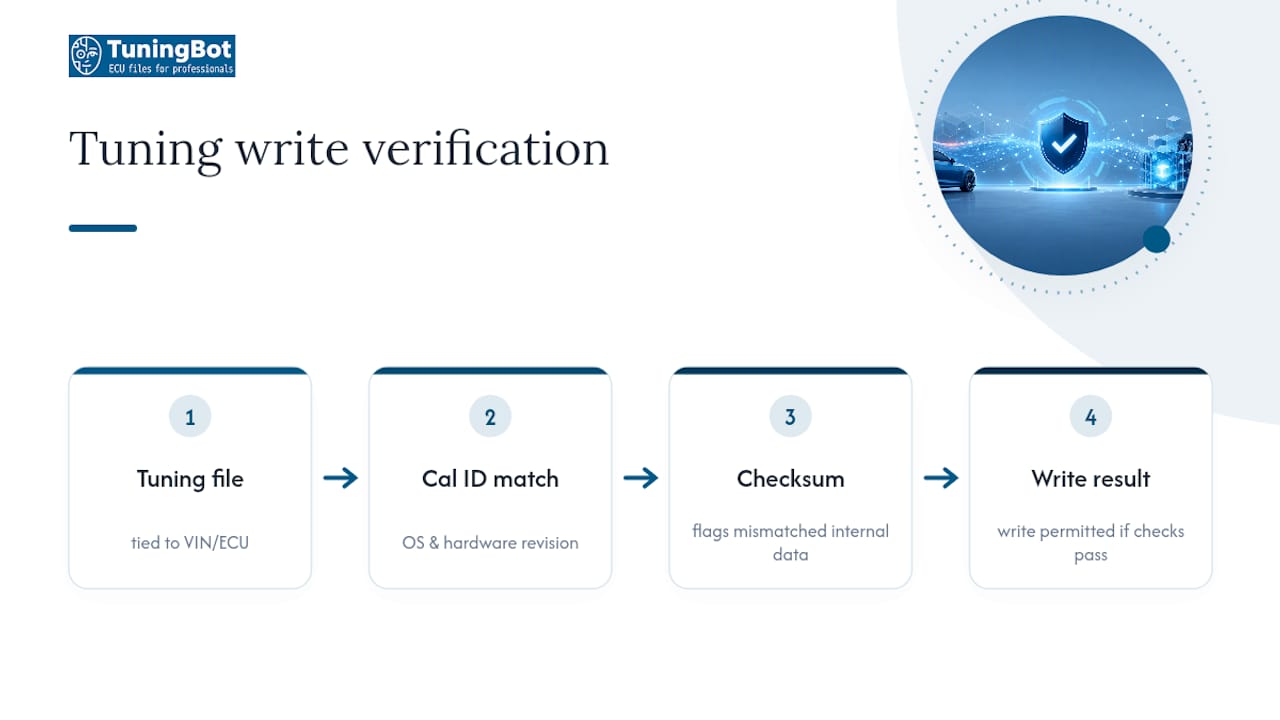
Compatibility and authorization can involve several layers: ECU/TCU identification, operating-system or calibration IDs, encrypted or signed file formats, platform licensing and ECU-side integrity checks. These mechanisms differ by tool and controller.
Platform licensing also controls how files can be read, edited and written within that vendor’s ecosystem. A community discussion can illustrate user experience, but the platform’s current official license terms remain the authoritative source.
Pro Tip: Before attempting any flash, pull your ECU’s calibration ID and cross-check it against the file’s documented cal ID. A five-minute check here prevents most compatibility errors before they happen.
The Technical Risks of Flashing Mismatched Files
Writing a mismatched or structurally invalid file can cause a failed write, no-start condition, limp mode, DTCs or—on some controllers—require recovery. The exact failure mode depends on the ECU, tool, protocol and which memory regions are being written.
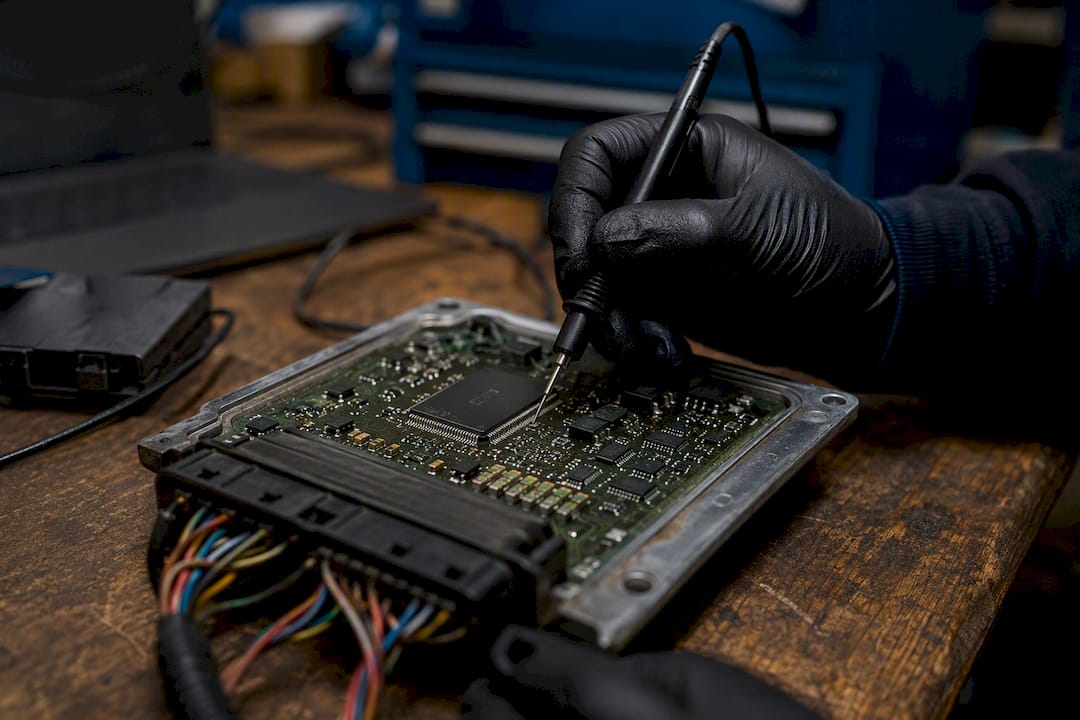
A calibration or software mismatch may be rejected by the tool or controller, or it may produce incorrect operation if the file is accepted. Do not assume that a superficially similar OS or calibration number is interchangeable.
Some commercial platforms enforce file compatibility before a write and reject files that do not match their supported calibration or software identifiers. This is platform-specific and should not be generalized to every tuning tool.
Pro Tip: Never assume a “close enough” cal ID is safe. A one-digit difference in the OS number can mean an entirely different sensor calibration table underneath.
Warranty, Emissions, and Liability Risks You Should Know
Using files outside the applicable software license or provider terms can create contractual, support and technical risk. Workshops should confirm both usage rights and technical compatibility before writing.
Calibration changes can also create emissions-compliance issues when they alter required emissions controls or monitored functions. The legal result depends on jurisdiction, vehicle use and the specific modification.
- Emissions noncompliance can trigger regulatory penalties depending on jurisdiction.
- Unverified flashes can void warranty coverage on the ECU or drivetrain.
- Shops assume liability for damage caused by unlicensed files.
Pro Tip: Add one line to every job form: “Customer confirms the supplied base file is an accurate, unmodified factory dump.” It’s a small step that meaningfully limits disputes later.
Legitimate No Credits Tuning Files Workflows
There are several legitimate no credits tuning files workflows for obtaining a compatible calibration without relying on an unverified repository file.
- Use the commercial platform’s normal licensed workflow where it best fits the job.
- Work with an authorized or appropriately licensed tuner who supports the exact vehicle and platform.
- Use vendor-approved OTS files only where the vendor confirms the exact vehicle, software and hardware requirements.
- Use a professional pay-per-file service when the workshop has a valid source file and wants calibration development outside a prepaid-credit model.
- Use community stock-file repositories only as reference or recovery research unless provenance, licensing and compatibility have been independently verified.
Some vendors include tuning files or revisions with qualifying products or memberships. Those programs are subject to the vendor’s eligibility rules and are not a universal substitute for licensing.
Pro Tip: If you’re choosing between a community OTS file and a pay-per-file service, weigh the cost of your time. A mismatched OTS file that bricks a controller costs far more in diagnostic hours than the service fee ever would.
A Safer Workflow for Handling Files Without Platform Credits
When using no credits tuning files through a separate pay-per-file workflow, keep the process licensed, compatible and recoverable rather than trying to circumvent the platform.
- Identify the ECU/TCU and preserve the original or source file available through the supported read workflow.
- Confirm that any OTS or third-party file is explicitly supported for the exact control-unit/software combination.
- Use the checksum, signature or integrity workflow required by the exact ECU and selected write tool.
- Use Bench or spare-controller validation only where the protocol and available hardware make it appropriate; it is not a universal requirement.
- Retain the available original/source file and enough identification data to reconstruct the job.
- Keep a documented recovery plan in case the flash fails.
- Never skip exact control-unit and software identification to save time.
Pro Tip: Validate the corrected file on a bench flasher whenever the hardware allows it. Catching an error on the bench costs minutes; catching it in the vehicle can cost the whole ECU.
What Credits, Tuners, and File Services Typically Cost
Commercial licensing and calibration costs vary by platform, vehicle and service. Compare the total job cost—including tool licenses, credits, file development, revisions and workshop time—rather than assuming one model is always cheaper.
No credits tuning files from pay-per-file services are charged by job rather than through prepaid credit balances. Turnaround and revision terms vary by provider and should be checked before ordering.
The Professional Case Against No-Credit Shortcuts
A workshop that writes an unverified or unlicensed file assumes unnecessary technical and commercial risk. A disciplined identification, backup, compatibility and validation process reduces that risk substantially.
Use a Pay-Per-File Calibration Service Without Prepaid Credits
For workshops researching no credits tuning files and already owning compatible ECU/TCU read-write hardware, TuningBot provides a pay-per-file calibration workflow without prepaid credit blocks.
Before ordering, check ECU and TCU Service Coverage, review the public Price List, and browse ECU services.
The workshop can submit its own supported source file through Tune Your File.
This does not bypass another platform’s licensing. It is a separate commercial workflow: the workshop uses its own supported read/write tool and purchases calibration work per file.
The workshop remains responsible for exact ECU/TCU identification, legal compliance, programming conditions and post-write validation.
Sources and Further Reading
- Engine Tune Repository — GitHub — community repository reference; provenance and compatibility must be independently verified.
- G8Board HP Tuners discussion — community discussion retained as requested; not an authoritative licensing source.
- Custom ECM Stock Tune File Repository — community stock-file archive retained as requested.
- AmericanMuscle Free SCT Custom Tune — example of a vendor-specific tune program with its own eligibility rules.
- TuningBot ECU ID Guide — internal control-unit identification reference.
- TuningBot Checksum Correction Guide — internal file-integrity workflow reference.
FAQ
What are no credits tuning files?
No credits tuning files are calibrations obtained through a workflow that does not require prepaid credit blocks, such as a pay-per-file service. They do not bypass the licensing rules of another tuning platform.
Can I get unlimited credits in HP Tuners?
Licensing models and credit requirements are platform-specific and can change. Check HP Tuners’ current official licensing terms for the exact controller and vehicle rather than assuming an unlimited-credit option exists.
Are ECU tunes illegal?
ECU tuning is not inherently illegal, but particular modifications can violate emissions, road-use, software-license or other rules. The result depends on jurisdiction, vehicle use and what the calibration changes.
Why are my HP Tuners credits not showing up?
Credit or license-display issues can have several causes, including account, interface, vehicle or software state. Use the platform’s current official support process rather than diagnosing the cause from forum reports alone.
Is there any free tuning software?
Some calibration or logging applications are free to download, but that does not grant ECU access, vehicle licensing, definitions or write authorization. Tool and controller compatibility still apply.
Can I avoid credits by supplying my own base file?
A workshop can use a separate pay-per-file calibration service with its own supported read/write workflow. That is an alternative business model, not a bypass of another platform’s licensing.