

 EnglishEN
 ItalianoIT
 DeutschDE
 PortuguêsPT
 FrançaisFR
 РусскийRU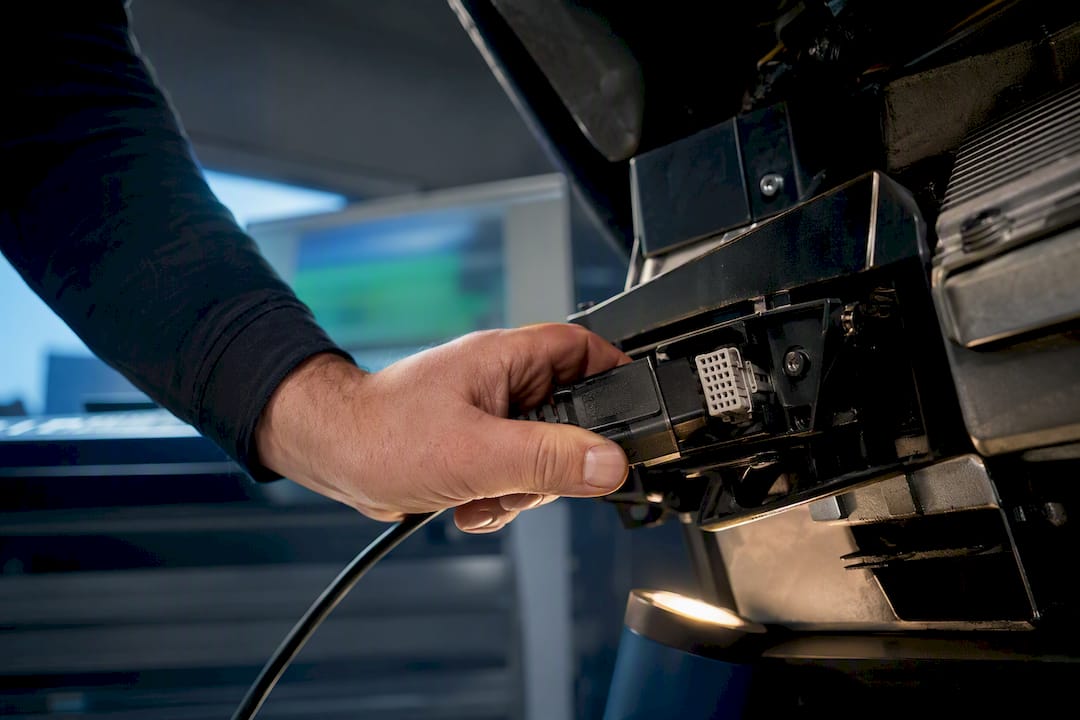
Keihin ECU tuning guide workflows should begin with exact ECU hardware/software identification and the read/write protocol supported for that specific unit. MCU family can help identify architecture, but it does not by itself determine OBD, Bench or Boot support, memory size, checksum strategy or editable map content. A professional workflow uses the exact ECU ID, source-file type and verified definitions before making calibration changes.
TL;DR:
- Keihin ECU support is ECU- and protocol-specific; MCU family alone does not determine the access method.
- Do not generalize memory size, OBD support or checksum behavior across SH, TriCore, SPC, M32R or RH850 families.
- Fuel, ignition, torque, boost, idle and mode-related maps vary by exact software and application.
- Checksum/signature/integrity handling should follow the editor/flasher workflow for the exact ECU.
- Validate the finished calibration with the signals and operating conditions relevant to that vehicle or motorcycle.
Keihin ECU Tuning Guide: MCU Families and ECU Identification
A Keihin ECU tuning guide should note that MCU identification helps classify the ECU architecture, but it should be combined with exact hardware/software IDs and tool coverage before any read, definition or calibration decision.
Keihin ECUs can use several processor families across automotive and motorcycle applications. Treat family names as architecture clues, not as universal workflow or memory-size guarantees.
- Renesas SH-family ECUs: exact SH variant, memory layout and tool support must be identified from the ECU/software.
- Infineon TriCore-based Keihin ECUs: access and recovery depend on the exact TC device and ECU implementation.
- SPC-based units: architecture and protocol support vary across motorcycle and automotive applications.
- M32R-based ECUs: often found in motorcycle applications, with software-specific map structures and modes.
- RH850-based units: newer Renesas architecture with ECU/software-specific read/write and calibration definitions.
MCU identification is useful, but it does not automatically tell you whether OBD, Bench or Boot access is supported. Check the exact ECU/tool protocol.
Keihin ECU Tuning Guide: Calibration Map Groups
Map availability depends on the exact Keihin software, engine, vehicle and definition set. Do not assume a fixed list of editable maps from the MCU alone.
- Fueling and injector characterization where exposed by the exact software.
- Ignition/spark strategy and corrections where applicable.
- Boost/air-control strategy on turbocharged applications.
- Torque request, throttle and load/airmass strategies where the ECU uses them.
- Idle, cold-start and warm-up strategies.
- Speed/RPM limits and mode-dependent calibrations where present.
- Diagnostic or feature flags only where their function is verified in the exact software.
Calibration content differs across Keihin applications and software revisions. Definitions should be matched and validated against the exact source file before editing.
Consejo profesional: Before touching a single cell, export the full definition set and cross-check it against the MCU you identified. A mismatched definition file is the single fastest way to edit the wrong address and corrupt a working calibration.
Keihin ECU Tuning Guide: Read/Write and File Integrity
Use the read/write mode explicitly supported by the tool for the exact Keihin ECU. OBD may be convenient where supported, but it is not inherently preferable to Bench or Boot for every job.
Bench or Boot may be required on some ECUs, but access mode depends on the current tool protocol and ECU state rather than one processor-family rule.
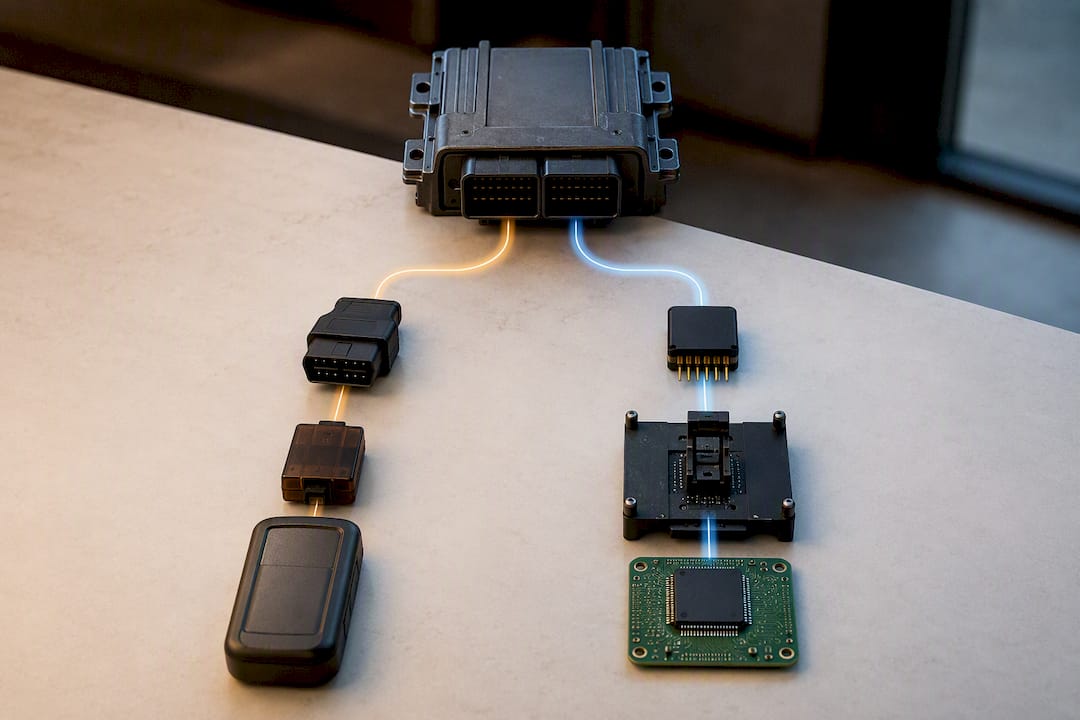
Checksum/signature/integrity handling varies by Keihin ECU, file format, editor and flashing tool. Some workflows correct integrity automatically; others require an explicit step.
A safe file-handling sequence looks like this:
- Identify the exact Keihin ECU hardware/software and supported flashing protocol.
- Preserve the untouched source file or read package exactly as produced by the tool.
- Use only definitions verified against that exact software revision.
- Apply calibration edits to the intended maps/regions only.
- Use the checksum/signature/integrity workflow required by the exact editor/flasher combination.
- Program with the supported method and retain the tool log for recovery/troubleshooting.
If a read/write fails, use the flashing tool’s recovery/logging procedure for that exact ECU rather than repeatedly retrying or assuming the file is corrupt.
Keihin ECU Tuning Guide: Professional File Workflow
Workshops can calibrate Keihin files in-house when they have correct definitions and validation capability, or outsource file work while retaining read/write and vehicle-side validation responsibilities.
- Submit the supported source file together with vehicle/engine details, ECU ID and requested objective.
- The file is reviewed against the exact Keihin software and available calibration definitions.
- Calibration changes are applied according to the requested service and hardware context.
- Integrity handling follows the exact ECU/file/tool workflow.
- The workshop writes the returned file with the supported protocol and performs final vehicle-side validation.
Processing time depends on the exact ECU, source-file type, requested service and available calibration information—not simply on MCU family or OBD versus Bench access.
Keihin ECU Tuning Guide: Validation and Datalogging
Validation should confirm the actual calibration objective using the signals available on that ECU. There is no universal logging list or fixed sequence that applies to every Keihin platform.
- Confirm ECU communication, DTC state and basic sensor plausibility after programming.
- Compare baseline and modified behavior under matched operating conditions.
- Log the relevant fueling, ignition, load/airflow, throttle, knock, boost and temperature channels available on that ECU.
- Validate mode-dependent tables or limiters only where the exact software actually uses them.
- Stop and diagnose abnormal knock, fuel-pressure, lambda, boost or temperature behavior before increasing load further.
Progressive validation is useful, but the exact sequence should match the engine, vehicle, transmission and available measurements rather than one generic recipe.
Consejo profesional: Log a full baseline pull on the untouched file before you change anything. Without it, you have no reference point to prove the tune actually improved anything beyond “it feels different.”
Keihin ECU Tuning Guide: Common Workshop Priorities
Common Keihin workflow risks include mismatched definitions, wrong source-file type, unsupported access assumptions and incomplete validation. Preserve the original source and exact ECU identification for every job.
— Equipo Técnico de TuningBot
How TuningBot Supports Keihin ECU Workflows
TuningBot can process supported Keihin ECU source files once the exact ECU, source-file type and requested calibration objective are confirmed.
For related technical context, use the verified ECU File Writing Guide, Flujo de trabajo del servicio de archivos de ajuste en línea y Reprogramación de ECU para profesionales.
Before ordering, check Cobertura del servicio ECU y las Lista de Precios Pública.
Submit a supported source file through Reprograma tu archivo.
This article stays technical and informational so commercial Keihin/ECU-file keywords remain concentrated on TuningBot’s service and order pages.
Sources and Further Reading
- ECUTools — Honda Keihin 1.5 Turbo Module — external technical/module reference retained unchanged.
- ECUTools — BitEdit Honda Moto Keihin — external technical/module reference retained unchanged.
- TuningBot — ECU File Writing Guide — verified internal programming reference.
- TuningBot — Online Tuning File Service Workflow — verified internal workflow reference.
- TuningBot — ECU Remapping for Professionals — verified internal calibration reference.
- TuningBot — ECU Service Coverage — verified internal coverage reference.
PREGUNTAS FRECUENTES
How Do I Tune a Keihin Carburetor?
Carbureted Keihin systems are mechanical, not ECU-calibrated. Jetting, needle and pilot adjustments are outside the ECU read/write workflow described here.
How Much HP Does ECU Tuning Add?
There is no universal gain. Results depend on the engine, hardware, fuel, ECU strategy, baseline calibration and requested limits.
Are ECU Tunes Illegal?
Legality depends on the jurisdiction, vehicle category and whether the calibration affects regulated emissions or safety systems. Road-legal work should preserve required emissions functionality.
Does Honda Own Keihin?
Keihin was historically closely linked to Honda and later became part of Hitachi Astemo through the 2021 integration with Hitachi Automotive Systems, Showa and Nissin Kogyo.