

 ItalianoIT
 DeutschDE
 EspañolES
 PortuguêsPT
 FrançaisFR
 РусскийRU
Audi TFSI ECU calibration guide workflows should start with exact engine and ECU identification, a clean diagnostic baseline and the read/write method supported by the flashing tool. Audi TFSI is not one universal calibration strategy: EA113, EA888 generations, MED9/MED17 and Simos variants use different torque, airflow, fueling, ignition and protection models. The professional approach is to use verified definitions and logs from the actual vehicle rather than apply fixed boost, ignition, adaptation-distance or Stage rules across every TFSI platform.
Do this before you touch a single map:
- Scan the vehicle and resolve relevant engine, fuel, boost and sensor faults before calibration.
- Record the exact ECU hardware/software ID, engine code, fuel grade, installed hardware and flashing-tool workflow.
- Verify high-pressure and low-pressure fuel-system behavior using the diagnostic channels appropriate to the exact Audi/VW platform.
- Preserve the original, virtual or server-supplied source file produced by the supported tool workflow.
- Use the regulated power support specified by the flashing-tool manufacturer before any write.
- Define post-write validation channels and stopping criteria before increasing engine load.
Warnings that apply to every Audi TFSI platform:
- Ignition, boost, lambda and torque changes must stay inside the fuel, turbo, thermal and knock-control capability of the exact engine.
- A fuel system that is already marginal at stock load should be repaired before calibration.
- ECU and TCU torque models should remain coherent where the transmission uses reported engine torque.
- Do not treat factory knock or lambda corrections as permission to run an aggressive base calibration.
Pro Tip: Never skip the baseline log just because a car “feels fine.” Marginal fuel systems and weak HPFPs often show no symptoms until you ask the engine for more than stock calibration ever demanded.
Audi TFSI ECU Calibration Guide: Key Takeaways
A professional Audi TFSI ECU calibration guide should separate engine/ECU identification, diagnostics, source-file handling, calibration development and vehicle validation instead of relying on one generic Simos or EA888 recipe.
| Point | Details |
|---|---|
| Identify the exact platform | EA113, EA888 generations, MED9/MED17 and Simos variants do not share one universal map structure. |
| Diagnostics come first | Fuel pressure, air/boost system, ignition/knock, DTCs and mechanical condition should be healthy before tuning. |
| Coordinate the torque/load model | Boost, ignition, fueling, airflow and torque-limit changes interact and should be validated together. |
| Stage labels are informal | Define calibration scope from the actual hardware, fuel and target rather than a generic Stage 1/2 label. |
| Adaptation is ECU-specific | There is no universal mileage that must elapse before a calibration can be evaluated. |
| Blog intent stays technical | This guide targets Audi TFSI calibration workflow and supports, rather than replaces, TuningBot service pages. |
Audi TFSI ECU Calibration Guide: What the ECU Actually Controls
Audi TFSI engine management coordinates torque request, cylinder charge/airflow, turbo control, ignition, lambda/fueling, cam timing and protection functions. Which maps control those functions depends on the ECU and software.
EcuTek documents distinct fast-path and slow-path concepts on supported VW/Audi EA888 Simos applications. That is a useful platform-specific model, not a universal description of every Audi TFSI ECU.
The core systems a calibration touches include:
- Boost control and wastegate/actuator duty tables
- Ignition timing and knock-response strategy
- Direct-injection fueling and lambda targets
- Camshaft timing and valve lift transition logic
- Torque request and torque-limiting tables
Knock control, lambda feedback and temperature protections provide corrective authority, but a good calibration should not rely on those protections to compensate continuously for an unsuitable base map.
How Do EA888 Generations and Simos ECUs Affect Tuning Strategy?
An Audi TFSI ECU calibration guide changes with engine generation, ECU software, turbocharger, fuel system, gearbox and vehicle configuration—not simply the Audi badge or model year.
Turbo, fuel-system, intercooling, engine and drivetrain limits set the physical boundary for calibration. Use component-specific data rather than transferring a power or fuel-capacity assumption from another EA888/EA113 application.
Vehicles with start/stop or electrified torque-assist functions require additional validation of torque transitions and drivability where those systems interact with engine torque management.
Treat engine-generation labels as orientation only; the exact ECU and hardware determine the usable calibration scope.
- EA888 Gen3: commonly paired with Simos/MED-series control depending on application; verify the exact ECU and turbo/fuel system.
- EA888 Gen4: calibration scope varies by vehicle, ECU software, turbocharger and emissions configuration.
- Newer/electrified EA888 applications: validate torque coordination and vehicle-system interaction in addition to the engine calibration.
What Pre-Tune Diagnostics Should You Run Before Calibrating?
Do not tune over unresolved faults. Establish a diagnostic baseline first so post-write changes can be separated from existing vehicle problems.
Run through this checklist in order:
- Read stored and pending DTCs, diagnose relevant faults and record the baseline; do not clear evidence simply to make the vehicle appear clean.
- Log requested and actual fuel pressure using the measuring values appropriate to the exact ECU/diagnostic system; legacy VAG group numbers are not universal.
- Review fuel/lambda adaptations using OEM/platform-specific normal ranges.
- Review injector/fuel-system diagnostic data where the ECU exposes meaningful correction or balance values.
- Check the intake, charge-air, PCV and turbo-control system for leaks or actuator faults before increasing load.
Baseline logging should include the channels relevant to the platform and calibration objective, commonly fuel pressure, requested/actual load or boost, lambda, ignition/knock and temperatures.
Use OEM/tool-specific tolerances for fuel pressure, fuel trims and injector data. There is no universal percentage or correction threshold that applies to every Audi TFSI ECU.
Audi TFSI ECU Calibration Guide: Read and Write Methods
Choose OBD, Bench, Boot or another access method from the current flashing-tool protocol for the exact ECU. OBD is not automatically ‘Stage 1 only’, and Bench/Boot are not inherently more or less reversible.
Common professional ecosystems include KESS3, AutoTuner, FLEX, CMD, Dimsport, PCMFlash and platform-specific calibration software. Use exact protocol coverage rather than general tool reputation.
- Alientech KESS3 — OBD/Bench/Boot coverage depends on the exact ECU protocol.
- PCMFlash — module-specific support; verify the exact Simos/MED ECU and required interface.
- AutoTuner — OBD/Bench/Boot availability is protocol-specific; Master/Slave file handling must match the workshop workflow.
- ProECU / EcuTek — platform-specific calibration and logging support on listed VW/Audi applications.
| Access method | Use when | Main consideration |
|---|---|---|
| OBD | The current tool protocol supports the required read/write operation | Stable vehicle power and communication; file may be virtual or partial depending on protocol |
| Bench | The protocol requires direct ECU connector access | Correct pinout, regulated power and exact ECU identification |
| Boot / low-level | The tool explicitly supports it for unlock, recovery or deeper access | Higher technical complexity; follow vendor instructions exactly |
| Server / virtual source file | The tool supplies a matched file from ECU identification | Valid within the supported workflow but not equivalent to a physical full dump |
Pro Tip: Keep the battery stabilizer connected through the entire write cycle, not just at the start. A voltage dip mid-write is one of the fastest ways to brick an ECU, and some Simos units carry TD1 trace risk during bench work that makes a stable connection non-negotiable.
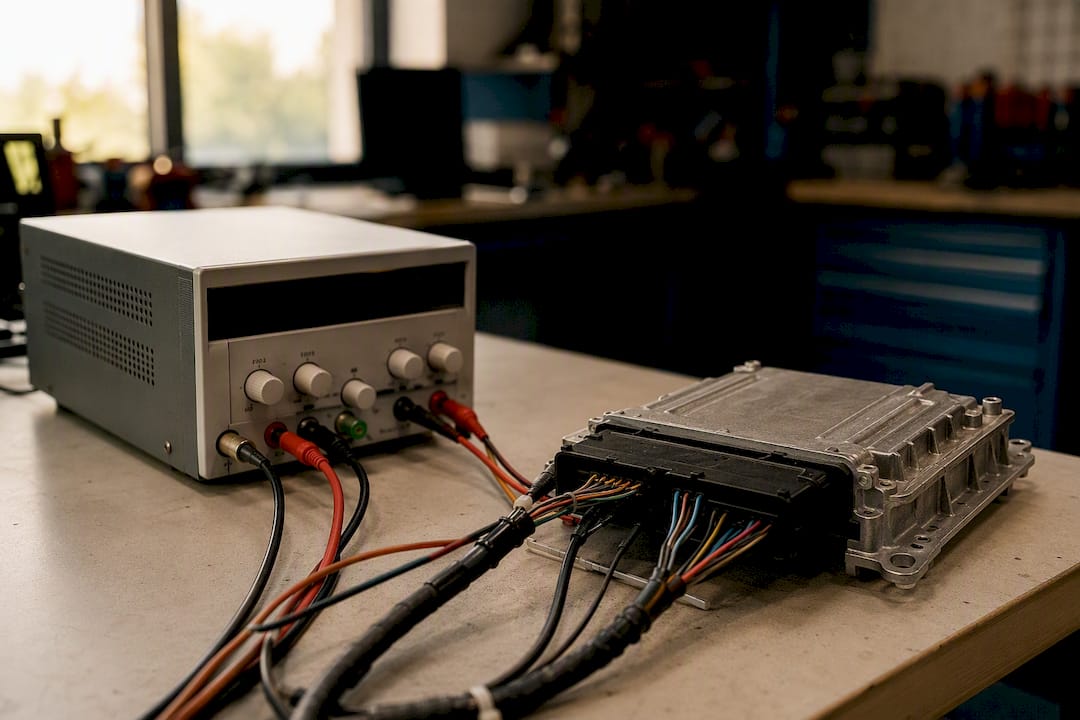
Confirm the flashing tool, protocol version and ECU identification before writing. If support is unclear, check the tool vendor’s current protocol database instead of guessing from a similar hardware number.
Audi TFSI ECU Calibration Guide: Professional Workflow
A disciplined workflow is identify, diagnose, preserve the source file, calibrate from verified definitions, write with the supported protocol, then validate progressively.
- Preserve the original, virtual, encrypted or server-supplied source file used by the supported read workflow.
- Capture a diagnostic/logging baseline appropriate to the calibration before increasing load.
- Change only the calibration areas justified by the target and measured response; avoid generic fixed increments.
- Write using the supported protocol and perform the tool-supported post-write verification where available.
- Confirm communication, DTC state and basic idle/low-load behavior before higher-load validation.
- Use controlled road or dyno validation according to the calibration scope and local safety/legal constraints.
- Re-log after the relevant ECU adaptations have had sufficient representative operation to update.
Define stopping criteria from the actual platform: unexpected knock correction, fuel-pressure deviation, lambda error, boost/load mismatch, excessive temperature or new DTCs should halt further load testing until understood.
Pro Tip: Raise boost and ignition together in small, matched steps rather than maxing one out before touching the other. A boost table pushed to its target with stock ignition timing underneath it just invites knock retard that erases the gain you were chasing.

Do not use universal ignition-degree or boost-percentage increments. The acceptable change depends on fuel octane, combustion response, turbo efficiency, temperatures and the engine’s current knock margin.
Which ECU Maps and Parameters Actually Get Edited?
Common calibration areas include torque/request, load/airflow, boost control, ignition, lambda/fueling, injector/fuel-system characterization and cam timing, but the exact maps vary by ECU software.
Each map needs its own verification check:
- Boost/load target: compare requested and actual values and check turbo/airflow limitations.
- Turbo actuator control: review overshoot, undershoot and actuator response using the platform’s available channels.
- Ignition/knock: evaluate timing and knock correction together with fuel quality, load and temperature.
- Lambda/fueling: compare commanded and measured lambda plus fuel-pressure/injector data where relevant.
- Injector/fuel-system characterization: use verified component data and the ECU’s actual model.
- Cam timing/valve-lift control: validate torque, airflow and drivability through transition regions.
- Torque limits/monitoring: keep engine and transmission torque models coherent where the platform exchanges torque data.
In an Audi TFSI ECU calibration guide, the important principle is system interaction: changing requested load or boost can affect fuel demand, ignition margin, torque monitoring, temperature and gearbox coordination. Use logs to determine which supporting areas actually need adjustment.
Keep every increment small and define a rollback threshold before you make the change, not after you see a problem.
What Power Gains Should You Expect at Each Stage?
Stage 1, Stage 1+ and Stage 2 are informal labels rather than technical standards. Define the calibration by installed hardware, fuel, legal configuration and intended output.
- Stage 1: commonly denotes calibration on stock hardware; the write method and reversibility are unrelated to the Stage label.
- Stage 1+: informal provider-specific label for minor hardware changes or additional calibration scope.
- Stage 2: informal label for calibration matched to specified supporting hardware; requirements vary by engine and target.
Power and torque gains vary substantially by engine, turbo, fuel, transmission and stock calibration. Use vehicle-specific dyno or log evidence rather than a generic Stage expectation.
Where the transmission uses engine torque information, ECU and TCU calibrations should remain coherent. A TCU change is not automatically required for every Audi TFSI remap.
Reversibility and emissions compliance depend on the exact software/hardware change, not the Stage label. Road-use work should preserve required emissions-control functions unless a lawful application-specific pathway exists.
Audi TFSI ECU Calibration Guide: Validation and Adaptation
Validation channels should be selected from the modified systems: requested/actual load or boost, lambda, fuel pressure, ignition/knock, temperatures and torque intervention are common examples.
Retain and calibrate the ECU’s existing protection strategies appropriately; do not assume every Simos variant exposes user-defined ‘auto rollback’ logic in the same way.
- Boost/load protection: retain suitable ECU protection and intervention strategies for pressure, torque and component limits.
- Knock control: preserve appropriate ECU knock-detection and timing-correction authority.
- Thermal protections: verify intake-air, coolant, oil and exhaust-temperature compensations relevant to the application.
Progress validation from idle/low load to part load and then higher load only after the vehicle remains fault-free and the measured data supports continuing.
Some adaptations require representative operating time after a flash, but the required duration and evaluation method are ECU- and parameter-specific.
What Are the Most Common Tuning Mistakes and How Do You Fix Them?
Common post-tune issues include fuel-pressure shortfall, lambda/fueling error, knock correction, torque intervention, boost/load mismatch and programming faults.
Immediate actions for each:
- Fuel-pressure shortfall: reduce load testing, diagnose low/high-pressure fuel supply and correct the hardware/calibration cause.
- Fuel/lambda correction: investigate leaks, fuel pressure, injector characterization, sensor accuracy and calibration.
- Knock correction: reduce load and investigate fuel quality, ignition, lambda, boost/load and temperature before continuing.
- Torque intervention: identify which engine, transmission, thermal or monitoring limiter is active before changing ceilings.
- Failed write: stop, preserve the exact tool state/log and follow the documented recovery procedure.
If programming fails, preserve the tool log and follow the flashing tool’s recovery procedure. Do not assume stock restore, Bench or Boot is automatically the correct next step for every ECU state.
Adaptation reset procedures are diagnostic-system and ECU specific. Dashboard or hidden-menu functions are unrelated to ECU calibration and should not be used as tuning or recovery tools.
Escalate when the ECU state, security condition or supported recovery path is unclear rather than repeating write attempts or changing access methods blindly.
A Calibration Engineer’s Take on Common Mistakes
The repeatable approach is to log, make only justified changes, and log again. The size and direction of each change should come from measured response, not a universal increment.
Pro Tip: Iterate on boost and ignition together, not in isolation. Chasing one number at a time just means you’re always one step behind where the tune actually needs to be.
How TuningBot Supports Audi TFSI Calibration Workflows
TuningBot can provide ECU and TCU calibration files for supported Audi/VAG workflows while the workshop remains responsible for vehicle diagnosis, reading, writing and final validation.
Before ordering, check ECU Service Coverage, review the public Price List and browse ECU services.
For tool and calibration context, use the verified AutoTuner Tool Guide, Fuel Map Tuning Guide and Turbo Tuning Map Optimization Guide.
Current platform coverage can be checked through the 2026 Solutions Update, and the source file can be submitted through Tune Your File without prepaid credits.
This article remains focused on Audi TFSI technical calibration intent so it supports, rather than cannibalizes, TuningBot’s transactional ECU tuning pages.
Sources and Further Reading
- EcuTek — VW AG EA888 Engine Tuning — external platform-specific Simos/EA888 technical reference retained unchanged.
- WJ Prototypes — motorsport CNC machining — external hardware-fabrication reference retained as requested; not an ECU calibration source.
- TuningBot AutoTuner Tool Guide — verified internal read/write workflow reference.
- TuningBot Fuel Map Tuning Guide — verified internal fuel/torque calibration reference.
- TuningBot Turbo Tuning Map Optimization — verified internal turbo calibration reference.
- TuningBot Engine ECU Programming Guide — verified internal programming reference.
FAQ
How Do I Reset the ECU on My Audi?
Reset and adaptation procedures depend on the Audi platform, ECU and diagnostic function. Use the manufacturer/tool-specific procedure rather than disconnecting the battery or applying a blanket reset.
Can I Tune My Own ECU?
In-house calibration is possible with the correct definitions, programming tools, diagnostics and validation expertise. Access method and risk depend on the exact ECU, not on a generic OBD-versus-Bench rule.
How Do You Access Audi’s Secret Menu?
Hidden instrument-cluster or infotainment menus are unrelated to ECU calibration and should not be used as substitutes for proper diagnostics or logging.
Which Audi Engines Have a Reputation for Problems?
Different TFSI generations have different known service issues. The relevant point for calibration is to diagnose the actual vehicle and resolve timing, fuel, boost, PCV, cooling or other faults before increasing load.
How Long Should You Drive After a New Calibration?
There is no universal mileage. Allow the ECU to experience the operating conditions required for the relevant learned values to update, then evaluate logs against the baseline.