

 ItalianoIT
 DeutschDE
 EspañolES
 PortuguêsPT
 FrançaisFR
 РусскийRU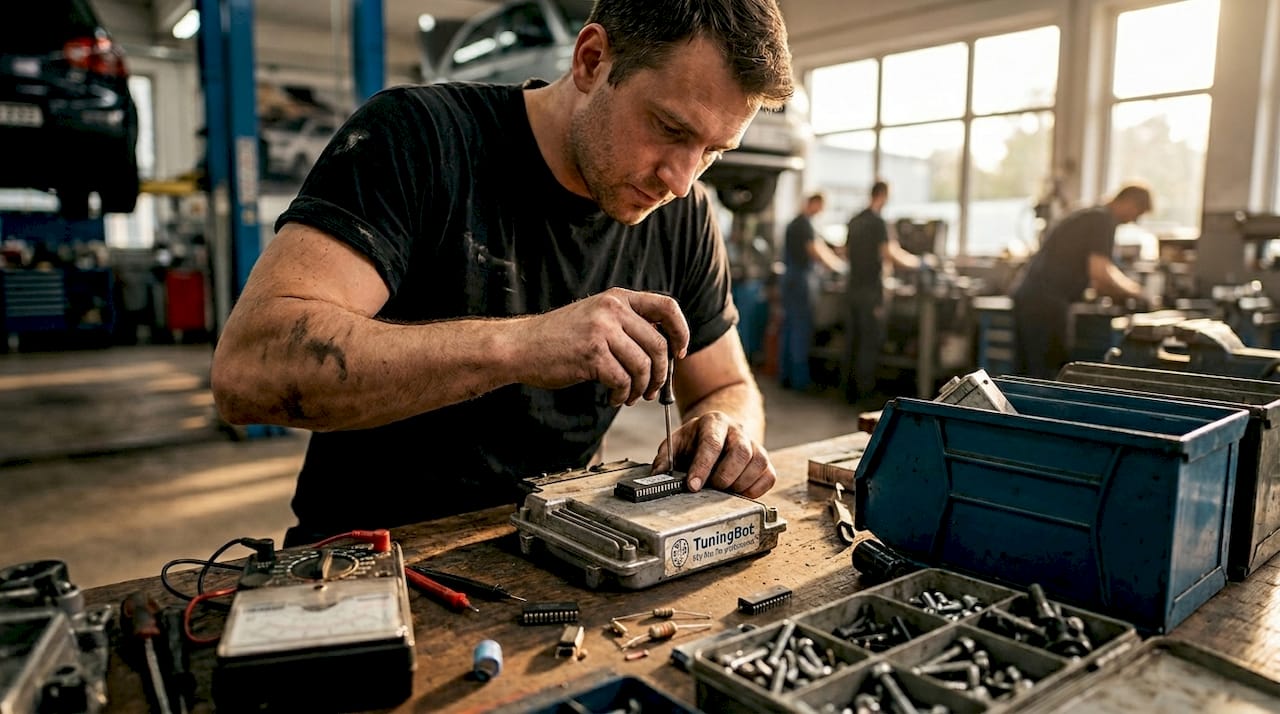
If you think what is chiptuning history amounts to a few guys tweaking software in the 2000s, the actual story runs much deeper. Chiptuning traces back to the earliest days of electronic engine management, when tuners literally desoldered chips from circuit boards to extract extra performance. The technology has since moved through piggyback systems, OBD-II flash tuning, and now fully remote calibration workflows. Understanding this progression is not just interesting for history buffs. It gives every working tuner and automotive professional sharper context for the tools and techniques used daily.
Table of Contents
- Key takeaways
- What is chiptuning history: from mechanics to microchips
- From piggyback systems to OBD-II flash tuning
- Modern chiptuning: remote calibration and intelligent devices
- Legal and industry tensions in chiptuning history
- The chiptuning evolution: a practical summary for enthusiasts
- My perspective on chiptuning’s past and future
- Professional ECU remapping files from TuningBot
- FAQ
Key takeaways
| Point | Details |
|---|---|
| Hardware origins in the 1980s | Early chiptuning required physical EPROM chip removal and replacement on factory ECU circuit boards. |
| OBD-II changed everything | The 1996 introduction of OBD-II ports enabled flash tuning through a single standardized diagnostic interface. |
| Piggyback vs. full remap | Piggyback devices intercept sensor signals without rewriting ECU software, making them reversible but limited in scope. |
| Encryption is the new barrier | Modern ECUs use encryption and security gateways that demand specialized tools and credentials to access. |
| Remote tuning is now standard | Email-based data logging and file delivery allow precise calibration without the vehicle ever visiting a dyno. |
What is chiptuning history: from mechanics to microchips
Before electronic engine control units existed, tuning was entirely mechanical. Technicians adjusted carburetor jets, advanced ignition timing by rotating the distributor cap, and modified camshaft profiles to shift the power band. These were skilled trades, but they had a hard ceiling. You could only go as far as the physical components allowed.
That ceiling cracked in the late 1960s and early 1970s when automakers began experimenting with electronic engine management. Volkswagen introduced one of the first production-car ECUs in the mid-1970s, marking the point where software entered the performance equation. The engine’s behavior was now defined partly by data stored on a programmable chip, and that chip could, in theory, be changed.
By the 1980s, a small community of specialists had figured out how to exploit this. Early chip tuning required physically desoldering EPROM chips from the ECU circuit board, reading the binary data with an external programmer, editing fuel and ignition maps using hexadecimal editors, and then burning a new chip with the modified data. The modified chip was then soldered back in, or more practically, a DIP socket was added to the board so future swaps were less destructive.
The process carried real risk. A miscalculated ignition advance could detonate the combustion chamber. Incorrect fueling maps under load led to lean conditions and damaged pistons. Most tuners worked from partial knowledge, comparing known-good calibrations and making educated adjustments. There was no undo button once the chip was burned.
- EPROM chips were one-time programmable in early implementations, meaning each mistake wasted a chip
- Socketing the ECU board became a standard workaround to allow repeated chip swaps
- Hex editing required deep knowledge of the ECU’s memory map, which manufacturers never published
- Failed tunes could cause misfires, detonation, or complete engine failure in worst-case scenarios
Pro Tip: If you encounter an older vehicle with a socketed ECU board, that socket is almost always the fingerprint of a previous tuner who prepped the board for chip swapping. It is not a factory feature.
From piggyback systems to OBD-II flash tuning
The 1990s produced two parallel developments that would redefine chiptuning techniques history. The first was the rise of piggyback tuning systems. Rather than altering the factory ECU directly, these devices sat between the ECU and its sensors, intercepting and modifying the signals before they reached the processor. The factory calibration remained untouched.
Piggyback systems run parallel to the factory ECU, intercepting sensor signals without rewriting ECU software, offering a reversible but limited tuning method. Unichip was among the earliest companies to develop this architecture into a serious product, with over 30 years of continuous refinement demonstrating just how far the concept could be pushed.
The second and more transformative development came in 1996 with the mandatory adoption of OBD-II in the United States. OBD-II ports enabled flash tuning via a standard interface, meaning a tuner could now connect a laptop to the diagnostic port and write directly to the ECU’s flash memory. No desoldering. No circuit modification. The tuning file was delivered as data through a cable.
| Method | Hardware modification | Reversibility | Access requirement |
|---|---|---|---|
| EPROM chip swap | Yes, physical board work | No (unless socketed) | ECU removal from vehicle |
| Piggyback device | Minimal (inline connector) | Yes, fully removable | Wiring harness access |
| OBD-II flash tuning | None | Yes, reflash to stock | Diagnostic port and software |
| Modern remote remap | None | Yes, via file upload | Tuning tool and ECU access |
The shift to OBD-II flash tuning accelerated chiptuning’s professionalization. Software interfaces with graphical map editors replaced hex editors. Tuners could now visualize fuel tables, torque limits, and boost pressure curves as three-dimensional maps rather than rows of hexadecimal values. Companies like Alientech and Dimsport built entire hardware and software ecosystems around this workflow, and those products remain central to professional calibration work today.

Pro Tip: When comparing tuning files from different calibrators for the same ECU, load them side by side in a map-comparison tool. The differences in load-site targeting and lambda strategy often reveal more about a calibrator’s skill level than any marketing claim.
Modern chiptuning: remote calibration and intelligent devices
The chiptuning development timeline from the 2000s onward is largely a story about accessibility and sophistication arriving at the same time. Remote tuning workflows, often called email tuning, represent the clearest example. Email tuning offers a remote, iterative calibration process using data logs sent via email, providing customized performance tuning without dyno visits. The vehicle owner or workshop logs a series of pulls under controlled conditions, sends the data file to a calibrator, receives an updated tune file back, and flashes it. This cycle repeats until the calibration is dialed in.
The practical implications for workshops are significant. A regional dyno facility is no longer required to produce a precise calibration. A tuner in one country can calibrate a vehicle located on the opposite side of the world, provided the data logging is done correctly.
On the piggyback side, Unichip’s 30-year evolution illustrates how intelligent add-on devices have moved far beyond simple signal interception. Modern iterations can manage ignition timing, fueling, and boost pressure with real-time lookup tables that adapt to operating conditions. They do not just fool sensors. They add genuine calibration logic on top of the factory map.
That said, not every add-on device deserves the same credit. Tuning boxes often merely deceive sensor data rather than performing real-time ECU adaptation, creating a performance illusion rather than true optimization. Rail pressure boxes that inflate fuel pressure signals are a classic example. The ECU sees a false reading, compensates by adding more fuel, and power increases, but the underlying calibration is never actually improved.
The most significant technical challenge in modern chiptuning is encryption. Flash tuning is becoming less straightforward due to encryption and security gateways in modern ECUs, with access requiring specialized tools and expertise. Manufacturers including Bosch, Continental, and Delphi have progressively locked their newer ECU families, requiring either bench-mode access via JTAG or BDM protocols, or proprietary authorization tokens that not all tuning tools can obtain.
- Bosch MED17 and EDC17 families require bench access or specific authorization on newer variants
- Continental SID series ECUs are among the most frequently encrypted in current European diesel platforms
- Security gateway modules on late-model FCA and newer VAG vehicles block OBD-II write access entirely without bypass procedures
Legal and industry tensions in chiptuning history
The origin of chiptuning was never purely technical. From the beginning, it existed in a gray zone between performance freedom and regulatory compliance. As the impact of chiptuning on performance became more measurable and publicly visible, manufacturers and regulators began paying closer attention.
Legal risks arise if tuning disables emissions equipment or causes a vehicle to fail tests, and customers must weigh legality and compliance when considering chiptuning. In the United States, the Clean Air Act prohibits tampering with emissions control systems, which technically includes recalibrations that alter EGR function, DPF regeneration cycles, or catalyst light-off strategies. Some calibrators produce what the industry calls “clean tunes” that stay within measured emissions thresholds, but the legal boundary is not always clearly defined.
Warranty concerns add another layer. Dealerships have progressively improved their ability to detect modified calibrations, often through ECU fault memory inspection, calibration identifier checksums, or kilometer-since-last-write counters stored in protected memory. A customer who tunes a vehicle under warranty and then experiences a drivetrain failure faces significant financial exposure.
The broader conflict between independent tuners and OEM software control is part of a larger dispute about digital ownership. Disputes over right-to-repair and digital ownership have shaped chiptuning’s development and public perception for decades. When manufacturers argue that ECU calibration data is proprietary software, they are asserting that the vehicle owner does not fully own the intellectual property governing their own powertrain. This tension has directly influenced how tuning tools are designed and how calibration files are protected within the professional tuning ecosystem.
“Chiptuning’s story reflects genuine tensions between innovation freedoms and corporate control over the software that defines how engines behave.”
The chiptuning evolution: a practical summary for enthusiasts
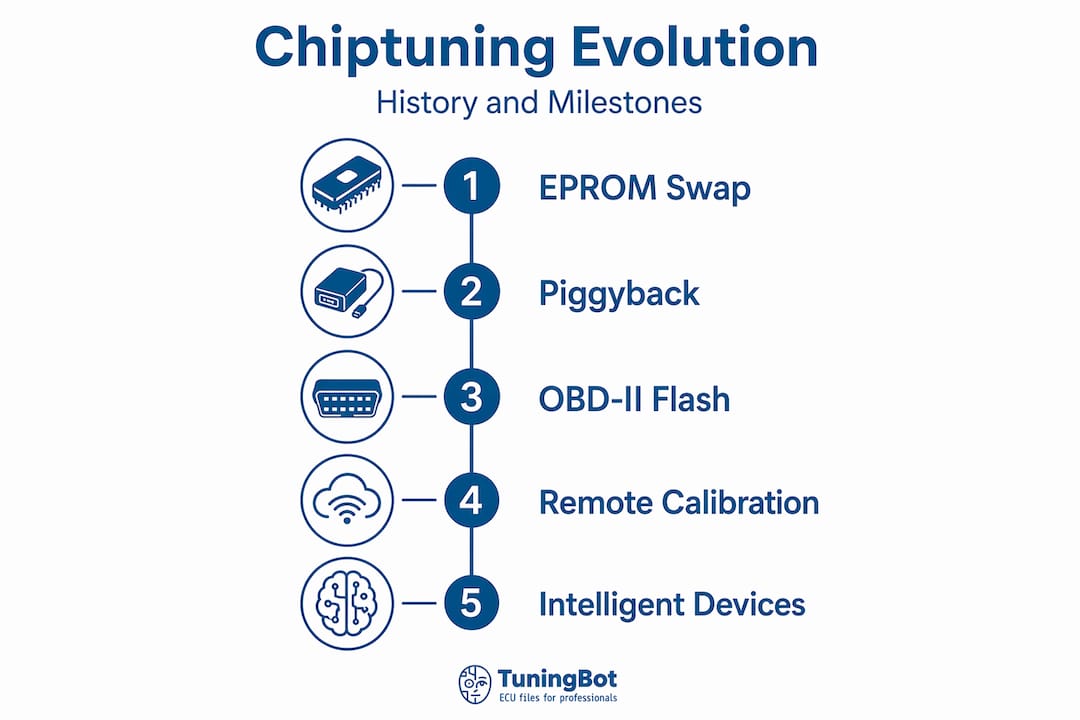
Looking at the full chiptuning evolution, the progression from mechanical carburetors to remote ECU calibration covers roughly five decades of technical change. Each era introduced a new set of tools, risks, and possibilities.
- Pre-electronic tuning (pre-1970s): Mechanical carburetor jetting, ignition timing adjustment, and camshaft selection defined performance limits.
- EPROM chip swapping (1980s to mid-1990s): Physical chip removal and replacement on ECU circuit boards. High skill requirement, high risk, no reversibility without rework.
- Piggyback devices (1990s onward): Inline signal interception devices that preserved factory calibration while adding performance adjustments. Reversible, but limited in scope compared to full remaps.
- OBD-II flash tuning (1996 onward): Diagnostic port access enabled non-invasive ECU writes. Graphical software replaced hex editors. Professional calibration became scalable.
- Remote and email tuning (2000s to present): Iterative calibration via data logs and file exchange removed geographic constraints from the tuning process.
- Encrypted ECU era (2010s to present): Security measures in modern ECUs require bench-mode access tools and specialized authorization, raising the barrier to entry significantly.
Pro Tip: Before purchasing any tuning solution for a specific ECU platform, confirm whether the tool supports read and write in OBD mode or only bench mode. Bench-capable tools add considerable cost but are increasingly required for late-model calibrations.
Safety, reversibility, and legal compliance remain the three non-negotiable considerations for any workshop working with ECU calibrations today. The technology will keep advancing. EVs and hybrid platforms will introduce new ECU architectures, and the tuning community will adapt as it always has.
My perspective on chiptuning’s past and future
I’ve spent years working with ECU calibration files across a wide range of platforms, and the thing that strikes me most about early chip swapping is not how primitive it seems now. It is how precise the people doing it had to be. Editing hex values in an EPROM with no graphical tools, no simulation, and no safety net required a calibrator to hold the entire memory map in their head. That discipline shaped the technical culture of tuning in ways that still show up in how the best calibrators approach their work.
What I find underappreciated in the history of chiptuning is how much the OEM industry shaped tuning culture by trying to block it. Every time a manufacturer encrypted a new ECU family, the tuning tool ecosystem responded with a new bypass method. That adversarial cycle accelerated tool development in ways that would not have happened otherwise.
The current moment feels like the most complicated in the field’s history. Encrypted ECUs, security gateways, over-the-air factory updates, and the prospect of fully software-defined vehicles all point toward an environment where access control is tighter than ever. I think the tuning community’s best response is not to fight that technically at every point, but to build professional credibility and legal clarity that make independent calibration a recognized and protected practice.
The software-based future is already here. The question is whether independent tuners will be written into that future or written out of it.
Professional ECU remapping files from TuningBot
Understanding the history of chiptuning gives you sharper perspective on what modern remapping actually represents. Decades of technical evolution led to where the industry stands today: precise, software-based calibration delivered without removing a single component from the vehicle.
TuningBot provides professional ECU remapping files for workshops and independent tuners worldwide. Upload your ECU file directly through the platform, no registration or prepaid credits required, and receive a calibrated file back from an experienced engineer. The service supports all major ECU brands including Bosch, Continental, Delphi, Marelli, and Denso, and works with leading tuning tools such as Alientech KESS3, AutoTuner, Magic Motorsport, and PCMFlash. Stage 1 through Stage 3 calibrations, DPF Off, EGR Off, DSG/TCU tuning, and DTC removal are all available through the same workflow. Fast delivery, transparent pricing, and direct engineer support make TuningBot a practical choice for professional calibration work at any volume.
FAQ
What is chiptuning history in simple terms?
Chiptuning history covers the evolution of engine performance modification from physical EPROM chip replacement in the 1980s to modern software-based ECU remapping via OBD-II ports and remote file delivery. Each phase introduced new tools and techniques while addressing limitations of the previous method.
How did chiptuning start originally?
Chiptuning started when technicians discovered that the EPROM chips storing calibration data in early ECUs could be removed, reprogrammed with modified fuel and ignition maps, and reinstalled to alter engine behavior. This required desoldering chips from circuit boards and working with hexadecimal data editors.
What did the OBD-II standard change for chiptuning?
OBD-II introduced in 1996 provided a standardized diagnostic port that allowed tuners to write calibration data directly to ECU flash memory without any hardware modification, making tuning faster, reversible, and accessible to a much larger professional community.
Is chiptuning legal?
Legality depends on jurisdiction and what the calibration modifies. Tuning that disables emissions equipment violates the US Clean Air Act, and modified vehicles may fail emissions inspections. Workshops should verify local regulations and clearly document the scope of any calibration before proceeding.
What is the difference between a tuning box and a full ECU remap?
A tuning box intercepts and modifies sensor signals before they reach the ECU without rewriting the underlying calibration, while a full ECU remap directly overwrites the factory maps stored in flash memory. Tuning boxes can deceive sensor data rather than producing real engine optimization, making full remaps the more precise and effective approach for serious performance work.