

 ItalianoIT
 DeutschDE
 EspañolES
 PortuguêsPT
 FrançaisFR
 РусскийRU
An online tuning portal is a specialized digital platform that centralizes ECU and TCU file exchange, order tracking, payments, technical communication and file delivery for automotive tuning professionals. The industry term is ECU file service platform, although workshops commonly use “online tuning portal.” A modern portal replaces scattered email chains, manual invoices and unsecured attachments with one traceable workflow. TuningBot goes further by avoiding the usual friction: workshops can check a public price list, upload a file without mandatory pre-registration and pay for the individual service without buying prepaid credit packages.
What is an online tuning portal and how does it work?
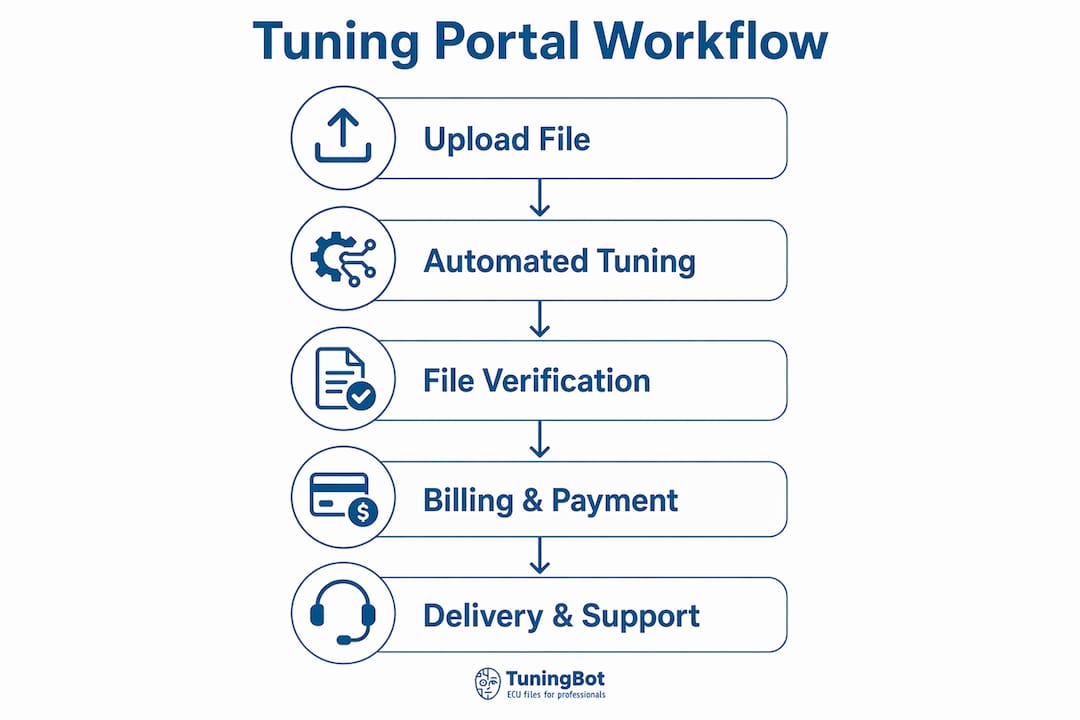
An online tuning portal is a web-based system that manages the full lifecycle of an ECU remapping order. A tuner or workshop uploads a binary file, selects the required service (Stage 1, DPF Off, EGR Off, IMMO Off, or DSG/TCU tuning), pays through an integrated billing system, and downloads the calibrated file when it is ready. Centralized portals replace email threads by giving customers a single location to upload files, track progress, and retrieve completed work. That structure eliminates the version-control errors and lost attachments that plague manual workflows.
The portal connects three parties: the workshop or end tuner, the file service engineer, and the billing system. Each order carries a complete record of the vehicle data, ECU type, requested modifications, and communication history. This means a workshop handling 50 orders per week can audit any file at any point without digging through email folders. The result is a traceable, repeatable process that scales without adding administrative staff.

What are the key features of online tuning portals?
Modern B2B tuning portals enable workshops to scale by integrating automated billing, client-specific dashboards, and encrypted file handling. Each of these features solves a distinct operational problem. Below are the core components every professional portal must include.
- Secure file upload and download. Encrypted transfer protects proprietary ECU and TCU binaries.
- Structured order data. Vehicle, ECU, software version, requested services and notes remain attached to the same job.
- File version history. Original reads, revisions and final deliveries stay clearly separated.
- Transparent payment workflow. A professional portal should show the service price before checkout. TuningBot uses public pricing and pay-per-file ordering instead of prepaid credits.
- Integrated technical communication. Questions, logs and calibration requests remain linked to the relevant file.
- Vehicle and ECU coverage tools. Searchable coverage helps workshops confirm support before ordering.
- Engineer review and automation. Routine workflow steps can be automated, while complex files are escalated to a real calibration engineer.
Portals built specifically for tuning businesses outperform general order management systems because they align with ECU file service workflows from the ground up. A generic e-commerce platform cannot handle checksum validation, ECU type filtering, or binary file versioning. A purpose-built tuning portal does all three natively.
How does an online tuning portal improve workflow and scalability?
The biggest operational gain from a tuning portal is the elimination of manual administrative work. The biggest mistake workshops make is ignoring the administrative burden of manual billing and file tracking until it becomes a bottleneck. By the time a workshop reaches 30 or more orders per week, manual processes actively limit revenue. A portal removes that ceiling.
Here is how the workflow improvement breaks down in practice:
- Order intake becomes structured. The client fills in vehicle data, ECU type, and service requirements through a guided form. The engineer receives a complete brief, not a vague email.
- File history is automatic. Every version of every file is stored against the order record. Rollbacks and audits take seconds, not hours.
- Invoicing runs without manual input. Automated billing systems manage invoices, customer balances, and payment confirmation without the engineer touching a spreadsheet.
- Client communication is centralized. Chat and push notifications linked to each order replace back-and-forth email threads and reduce response time.
- User roles control access. Senior engineers see all orders; junior technicians see only assigned work. This prevents accidental file overwrites and protects client data.
Pro Tip: Use the user role system to create a “client view” for each workshop account. Clients who can track their own order status in real time send fewer status-check messages, which frees your engineers to focus on calibration work.
The shift from manual email communication to centralized platforms is driven by scalability needs. Automating administrative tasks is the primary mechanism for business growth in ECU file services. A workshop that processes files through a portal can double its order volume without doubling its admin time. That ratio is the core business case for adopting a portal. For a detailed look at how this applies to workshop operations, the tuning file service workflow guide covers the full process from intake to delivery.
What is the role of automation and tuning bots?
Automation inside a tuning portal should handle repetitive workflow steps—file classification, status updates, notifications, validation routines and routing—without pretending to replace calibration judgment. Standardized operations can be accelerated, but complex torque structures, unusual software versions and custom performance requests still require a qualified engineer.
A tuning bot typically handles:
- Checksum correction. After map changes are applied, the bot recalculates and writes the correct checksum so the ECU accepts the file.
- Map application. For standard requests (Stage 1 power gains, DPF Off, EGR Off), the bot applies a predefined map set to the original file.
- File delivery. Once processing is complete, the bot triggers the download link and sends the client a notification automatically.
Automation can shorten turnaround for routine workflows, but delivery time depends on the ECU family, requested services, file condition and whether engineer review is required. A professional portal should prioritize file correctness and traceability over a universal speed promise.
Tuning bots do not replace human tuners but accelerate repetitive steps, allowing engineers to focus on complex calibrations. Portals with bot automation include a manual queue fallback for files the bot cannot process. This keeps the workflow moving without sacrificing quality on edge cases. Tools like Alientech KESS3, AutoTuner, and Magic Motorsport integrate with portal workflows to support both automated and manual processing paths.
What should professionals consider when choosing a tuning portal?
Selecting the right portal is a business decision, not just a technical one. The platform you choose determines how your clients experience your service and how efficiently your engineers work. The criteria below separate purpose-built tuning portals from generic alternatives.
Security and file integrity are non-negotiable. The portal must use encrypted file transfer and store binaries in a way that prevents unauthorized access or accidental deletion. ECU files contain proprietary calibration data; a breach damages client trust permanently.
Dashboard depth determines daily usability. A portal with a shallow admin view forces engineers to work around the system. Look for order filtering by ECU type, vehicle, service category, and status. Client dashboards should show order progress without exposing internal notes or pricing structures.
Pricing transparency affects both cash flow and workshop trust. Credit wallets may suit some dealer networks, but they force customers to commit funds before knowing how many jobs they will process. A public price list and pay-per-order model is clearer for occasional and high-volume users alike. TuningBot publishes its prices and does not require prepaid credit packages.
ECU and vehicle database support directly affects order accuracy. A quality tuning portal must include support for detailed vehicle and ECU databases to speed tuning and reduce errors. When clients can search by Bosch ECU part number or P-code, they submit better briefs and engineers spend less time clarifying requirements.
Scalability and workflow customization determine long-term fit. A portal that works for 10 orders per week must also work for 200. User role management, automated routing, and configurable service categories are the features that make this possible. For workshops building toward that scale, the ECU tuning workshop business model guide outlines the operational structure that supports growth. Tracking modifications accurately throughout this process is also critical; resources like car modification tracking help workshops maintain clean records as order volume increases.
Key Takeaways
An online tuning portal is the operational backbone of a professional ECU file service, combining secure file exchange, automated billing, and structured communication into a single platform that scales with your business.
| Point | Details |
|---|---|
| Core definition | An online tuning portal centralizes ECU file exchange, billing, and client communication in one system. |
| Automation role | Tuning bots handle checksum correction and map application, freeing engineers for complex calibrations. |
| Workflow impact | Automated billing and order tracking eliminate manual admin work that bottlenecks growth at scale. |
| Selection criteria | Prioritize encrypted file handling, ECU database support, and flexible billing when evaluating portals. |
| Scalability driver | User role management and configurable workflows allow portals to support high order volumes without added staff. |
The case for committing fully to portal-based operations
A tuning portal creates its greatest value when the workshop uses it as the single source of truth for files, messages, payments and revisions. Keeping a parallel email or messaging workflow reintroduces the same versioning and traceability problems the portal was meant to eliminate.
Adoption does require discipline: technicians must submit and retrieve files through the portal, and customers must learn to attach every request to the correct order. Once that habit is established, the workshop gains a clean audit trail and significantly less administrative work.
Automation should support engineers, not replace them. The strongest model combines structured order intake and repeatable validation with human review whenever the ECU variant, requested calibration or diagnostic context falls outside a routine case.
The future of ECU file services belongs to platforms that combine transparent pricing, secure delivery, revision control and real technical support. That is how a small workshop can operate with the consistency of a much larger organization.
— TuningBot Technical Team
Why TuningBot is a stronger online tuning portal for workshops
TuningBot is designed around the practical needs of workshops: clear public prices, direct file upload, no mandatory pre-registration and no prepaid credit wallet. The workshop can understand the cost before ordering instead of contacting a dealer or committing money to an opaque credit system.
The portal supports ECU and TCU work across Bosch, Continental, Delphi, Marelli, Denso, Siemens, Keihin and ZF applications. Services include Stage 1, Stage 2, Stage 3, checksum correction, DTC management, IMMO solutions, DSG/TCU tuning and other supported calibrations. Coverage can be checked before ordering through the ECU and TCU Service Coverage page.
Workshops can review the public Price List, browse the available ECU services, and then upload the file directly. The workflow is compatible with common professional tools including Alientech KESS3, AutoTuner, Magic Motorsport, CMD, Dimsport and PCMFlash.
The real advantage is not only speed. TuningBot combines file delivery with traceability, pricing clarity and access to real engineer support. That makes it easier for workshops to quote customers, avoid version confusion and complete one-off or high-volume jobs without administrative friction.
FAQ
What is an online tuning portal?
An online tuning portal is a web-based platform that manages ECU file uploads, calibration orders, billing, and client communication in one system. It replaces manual email workflows with a structured, auditable process.
How does online tuning work for workshops?
A workshop uploads an ECU or TCU file, selects the required service, provides the vehicle and calibration details, pays for the individual order and receives the completed file through the platform. With TuningBot, no prepaid credit wallet or mandatory pre-registration is required.
What do tuning bots actually do?
Automation can classify files, run validation routines, update order status and route standard jobs. It should not replace engineering judgment on complex calibrations, unusual ECU variants or vehicle-specific diagnostic issues.
What are the benefits of online tuning portals over email-based services?
Portals provide encrypted file transfer, automatic version history, real-time order tracking, and integrated billing. Email-based services offer none of these, and they break down as order volume increases.
How do I choose the right online tuning portal for my workshop?
Prioritize secure file handling, clear service coverage, public pricing, revision history and access to qualified technical support. Avoid portals that hide prices behind dealer contact, require large prepaid credit balances or provide no clear escalation path to an engineer.